Agent Transcript Storage and Retention for Compliance and Debugging
Agent transcripts need their own retention rules, not a one-size-fits-all log deletion schedule.
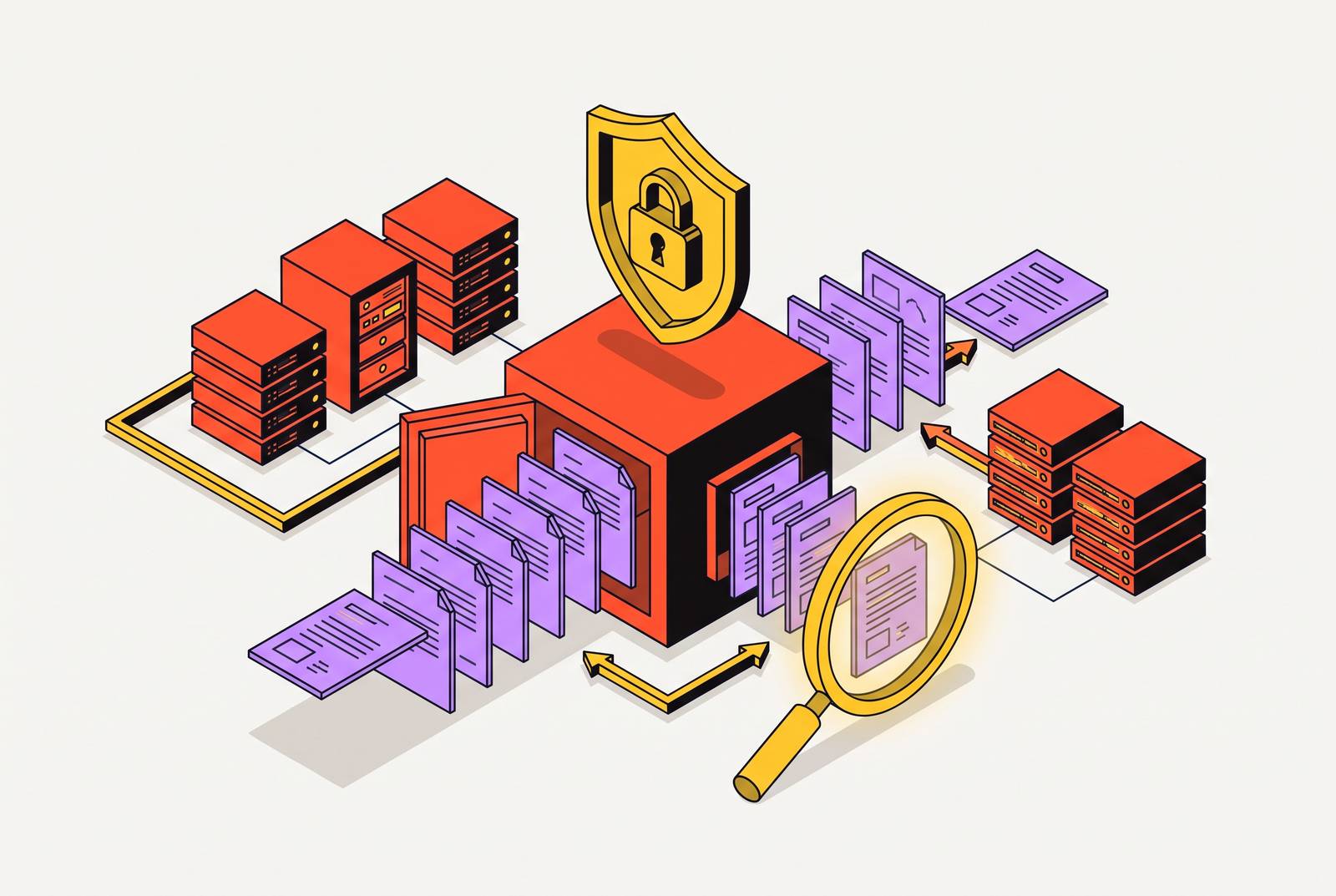
Agent transcripts break the assumptions that log retention policy was built on. A reasoning trace isn't a log line, a tool call isn't a stack trace, and a piece of long-term memory isn't a record with a natural expiration date. Compliance and debugging both depend on treating each of these as a distinct object with its own storage location, legal weight, and shelf life, rather than forcing all of it through a retention schedule written for deterministic software.
Why agent transcripts are not just another log format
Traditional software logs are boring in the best possible way. A request comes in, a code path executes, an error either fires or it doesn't, and the log line reflects a deterministic sequence of events. Retention policy for that kind of data is a solved problem: pick a window, roll it off, done.
Agent transcripts don't behave like that. A single agent session might generate ephemeral scratchpad reasoning that never gets shown to anyone, a series of tool call invocations carrying live parameters (often raw PII, mid-conversation, unlabeled), skill invocations with intermediate outputs, a final deliverable such as generated code or a sent message, and updates to long-term memory that persist well past the session itself. Each of those artifact types carries different legal weight, a different useful lifespan, and often lands in a different storage system.
Treating all of it as one undifferentiated stream is the foundational mistake, and it produces a predictable failure mode: the data swamp. Without classification at the point of capture, the handful of records that actually matter for an audit or a regression investigation drown in terabytes of scratchpad noise. Nobody can find the transcript that matters, because it looks identical, in storage, to ten thousand transcripts that didn't matter.
The hidden storage locations most policies never map
A retention policy that lives in a document is a description of an intention. It's a description of an intention. The gap between what a compliance team believes happens to agent data and what the tooling actually does with it is where most exposure lives.
The real retention period for any piece of data is always the longest copy of it that exists anywhere. If the primary transcript store deletes after 30 days but a debugging tool, an analytics pipeline, or a third-party observability vendor holds a copy for longer, the effective retention is that longer period, full stop. A policy that only governs the primary store isn't a policy, it's a false sense of security.
For voice and conversational agents specifically, personal data tends to accumulate across four layers, and each one needs its own accounting. The transcript itself holds personal data in plain readable text. The audio recording carries the same content plus the speaker's voice, which many privacy frameworks treat as sensitive biometric data. Traces and logs, meant for engineers debugging a system, quietly absorb tool call parameters and debug payloads, which is how PII ends up sitting inside a monitoring dashboard nobody thought of as a data store. And downstream systems, CRM records, webhook payloads, automation runs triggered by the agent, can end up disclosing personal data to third parties without anyone having established a legal basis for that disclosure.
That third layer deserves particular attention. When an agent calls a function mid-conversation, whatever parameters it passes is unfiltered in the log, because the logging layer was built to capture function calls, not to know that one of the arguments happens to be a government-issued identification number. Nobody designed the layer to hold sensitive data on purpose, and teams underestimate it most consistently as a result. It just ended up there.
Classifying agent data before writing a single retention rule
Before any retention period gets written down, three questions need an answer for every artifact type an agent produces. What has to be kept for compliance. What should be kept because it improves agent performance or preserves memory. And what can be deleted outright, because keeping it only adds storage cost with no offsetting value.
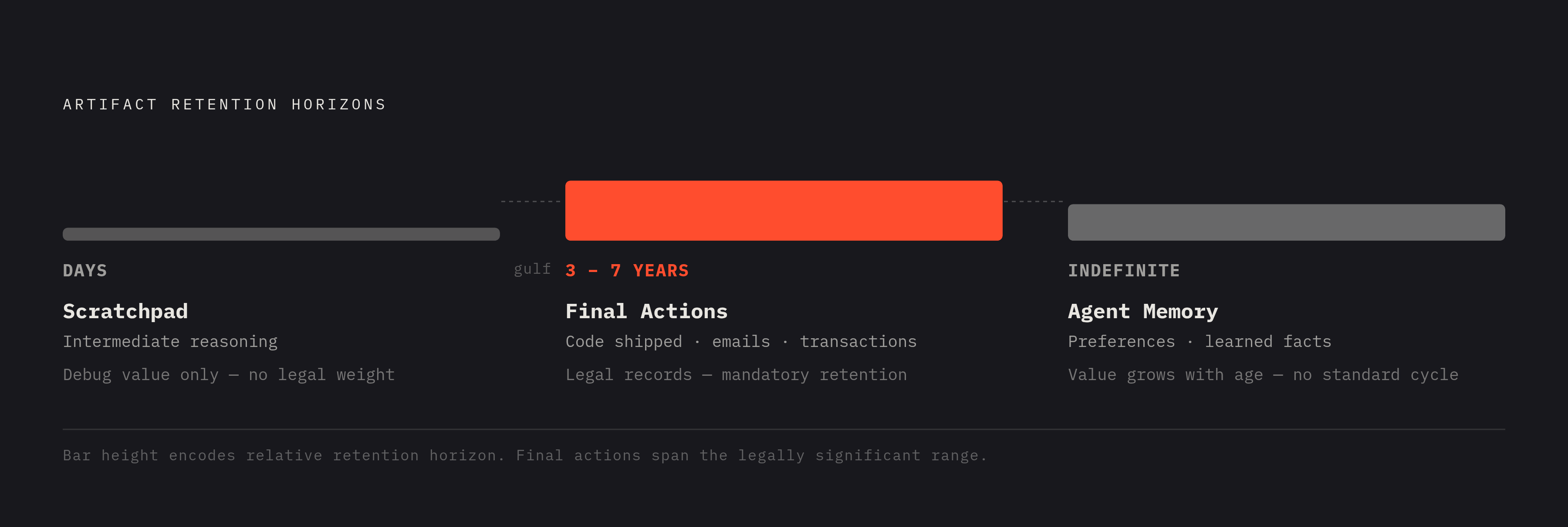
The most useful way to answer those questions is to split on thought versus action. Intermediate reasoning steps, chain-of-thought traces, the scratchpad an agent uses to work through a problem, carry high debugging value in the short term and essentially no legal weight. A short-term retention window covers the period when a bug or regression is likely to appear and someone needs to go look at what the agent was actually thinking. Final actions and outputs sit at the opposite end. Generated code that ships, an email an agent sends, a transaction it executes: those are legal records, and depending on the industry, they need multi-year retention, often somewhere in the 3 to 7 year range.
There's a third category that doesn't fit either bucket: long-term agent memory. User preferences, learned facts, the accumulated knowledge base an agent draws on across sessions. This data gets more valuable with age, not less, which makes it fundamentally incompatible with standard deletion cycles. Rolling it off on a short scratchpad-style cycle destroys the thing that makes the agent useful.
None of this works as an afterthought. Classification has to happen at ingestion, routing each artifact type to the right storage tier the moment it's created, rather than as a tagging exercise applied retroactively to a data lake that's already six months deep in undifferentiated records.
What compliance frameworks require from agent transcript records
There's a real gap between how prepared organizations believe they are and how prepared they actually are. Surveys on enterprise AI governance describe a large majority of companies now employing a Chief AI Officer, yet only a small fraction of leaders believe their organization has adequate governance in place. That gap between title and readiness is exactly where transcript retention failures happen.
The EU AI Act is the sharpest deadline on the calendar, with enforcement arriving August 2, 2026. High-risk application domains under the Act require conformity assessments, defined human oversight mechanisms, and six months of log retention, and none of that is a future planning item; it applies to systems already in production. A compliance architecture for an EU-facing agent deployment needs to document the agent's decision logic and tool invocation patterns, assess whether its application domain triggers high-risk classification, implement human oversight with concrete escalation thresholds, build in a stop or correction control a human can actually invoke in real time, establish six-month log retention with tamper-evident storage, and map whatever General Purpose AI obligations apply if the underlying model qualifies. Legal commentary on the Act has flagged that audit logs for high-risk systems may end up needing retention measured in years, not months, as regulatory guidance matures. Six months is a floor, not a target.
This particular country has no single federal standard, but the sector-specific obligations that exist have real enforcement teeth. HIPAA requires six years of retention for covered records, and any agent that touches Protected Health Information inside a retrieval-augmented pipeline is in scope, regardless of how the vendor relationship is structured; a Business Associate Agreement does not absolve anyone if the underlying model is still logging inputs somewhere. SOX requires seven years for financial records. FINRA and the SEC have issued AI-specific guidance that bears directly on autonomous agents operating in their respective domains. And for voice AI making outbound calls, TCPA exposure means retention should extend well beyond the session itself, with longer windows warranted where HIPAA obligations overlap, given HIPAA's six-year retention requirement for covered records. Every call needs to produce a structured artifact, including timestamp, called party, agent identity, the opening disclosure transcript, the full conversation transcript, sentiment markers, any revocation events, and a citation back to whatever consent record the system relied on at the moment it dialed.
GDPR takes a different shape. There's no fixed retention floor, but Article 5's storage limitation principle requires a defined, justified, and technically enforced retention period, documented in the record of processing activities. "We kept it because we might need it" isn't a justification GDPR recognizes.
The architectural decision between zero data retention, full retention, and tiered approaches
Zero Data Retention needs a precise definition, because the term gets used loosely. ZDR means prompts, context, and model outputs are processed entirely in-memory during a session and never written to persistent storage. It's an architectural constraint that makes persistence technically impossible, not a 30-day deletion policy dressed up in stricter language.
For the highest-sensitivity workloads, ZDR is the correct answer, because it removes exposure at the point it would occur rather than trying to manage exposure after the fact through access controls and deletion jobs. Data that never gets written down cannot later be breached, leaked, or subpoenaed.
ZDR at the model provider level does not replace redaction, and it never was supposed to. A provider running ZDR says nothing about what your own observability platform, your CRM, or your application logs capture on the way in or out. The two measures solve different problems and need to run in parallel; neither one is a substitute for the other.
Auditability doesn't disappear under ZDR, either. Timestamps, token counts, policy outcomes, and anomaly flags can all satisfy an auditor's requirements without a single prompt or response ever touching disk. The record of what happened doesn't require a record of what was said.
PII redaction at ingestion: protecting transcripts before they reach the store
The premise behind redaction is straightforward: the analytical value of a transcript survives the removal of the personal data inside it. Conversational flow, tool call sequencing, and the structure of an agent's reasoning stay intact once names, numbers, and addresses are stripped out.
Spoken and conversational transcripts make this far harder than it looks on a web form, where a phone number sits cleanly in a labeled field. In conversation, that same phone number might get spelled out digit by digit, split across three separate turns, or restated halfway through because the speaker misspoke the first time. Those three patterns, spelling values aloud, splitting a value across turns, and mid-utterance self-correction, defeat simple pattern matching. And on the audio side, speech-to-text timestamps generally aren't precise enough to cut out a single word cleanly, which pushes the conservative approach toward removing the entire conversational turn rather than attempting surgical excision.
Three approaches exist, and each comes with a real trade-off rather than a free lunch. Regular expressions are fast, cheap, and reliable against structured formats like card numbers, but they fail the moment a value is spelled out or split, and the rule set needs constant upkeep as new failure patterns appear in production use. Named entity recognition models improve recall but still struggle with context that spans multiple turns, and they need periodic retraining to stay current. LLM-in-context redaction handles spelling, cross-turn splitting, and self-correction reasonably well, at the cost of higher latency and compute, though that cost can be absorbed by running the pass asynchronously rather than inline. It also tends to over-redact rather than under-redact, which, for a compliance function, is the direction you want a system to fail in.
Most teams that take this seriously end up combining the two: regex for structured, high-confidence formats, backed by a model-based pass over the surrounding conversational context to catch what pattern matching misses.
Retention rules for agent transcripts in agentic coding pipelines specifically
Coding agents generate a set of artifacts distinct from customer-facing conversation logs, and each needs its own retention logic rather than borrowing wholesale from the categories above.
Reasoning traces tied to a specific pull request or code change carry high debugging value and a short useful life; once the change has been reviewed and shipped without issue, the trace's value drops fast. Tool call logs recording which skills an agent invoked, in what order, against which files, matter for reconstructing how a change came together. CI failure context is genuinely perishable: by the time a failure notification reaches a human, the agent's context window that produced the failing change is already gone. That context has to be captured and surfaced proactively at the moment of failure rather than reconstructed later. Merge queue decisions and conflict resolution steps can carry audit weight in regulated industries, where knowing how a conflict got resolved matters as much as the resolution itself. And the agent harness configuration active at the time of execution needs to be retained too, since reproducing a failure later requires knowing what environment produced it.
The debugging case for keeping reasoning traces around for a meaningful short-term window is simple: without them, figuring out why an agent quietly regressed some untested corner of a codebase turns into guesswork.
There's a performance argument here too, separate from debugging any single incident. Looking at transcript data across many runs is the only reliable way to see which skills an agent actually invokes versus which ones sit in the skill set unused. A bloated skill set degrades performance, and that degradation is invisible without transcript analysis over a meaningful sample window, which by definition requires retention beyond the lifespan of any one debugging session.
And where generated code ships to production, where deployments run automatically, where an agent executes a financial transaction on someone's behalf, those are final actions in the same legal sense as a signed document or a filed record. They may fall under SOX, HIPAA, or whatever sector-specific rule governs the business the agent is operating inside, so multi-year retention isn't optional; it is the price of letting an agent act autonomously in a regulated environment.
Sources
- AI Agent Data Retention Policies: Best Practices 2026
- Zero Data Retention for AI Agents: The Enterprise Security Standard | NeuralTrust
- The 2026 TCPA Compliance Playbook for Voice AI Outbound | Retell AI
- AI Agent Data Retention Rules: Healthcare, Finance & Gov
- zylos.ai
- What do teams get wrong about transcript logs in agent workflows?
- What Is AI Agent Data Retention? Definition & Examples
- hamming.ai