Merge Conflict Resolution Strategies in Agentic CI Pipelines
Agents writing code in parallel need merge queues built for machine-speed concurrency.
Agentic software development has produced a new category of operational failure: merge conflicts generated not by the usual friction of distributed teams, but by autonomous systems writing code in parallel at a pace and density human-centric tooling was never built to absorb. This pattern is structural: fleets of coding agents need their own git workflows, built for their own failure rates, not ones borrowed from human contributors.
Why AI agents produce more frequent, harder-to-catch merge conflicts
A study of agent-authored pull requests conducted by Xu and colleagues examined tens of thousands of PRs and found that a sizable share of repositories contained agent-authored PRs that overlapped in time exactly, down to the moment of submission. Those overlapping pairs were not a marginal subset. They made up the vast majority of all agent-generated pull requests in the dataset, so when agents edit the same codebase, concurrent contention is the normal condition of agentic development, not an occasional collision.
That finding reframes the whole problem. Human developers, working across a sprint, tend to stagger their commits: someone picks up a ticket, works it over hours or days, and opens a PR when ready. Coding agents do not work that way. You can spin them up in parallel, assign them overlapping scopes, and set them loose on a repository at machine speed, with none of the informal signaling that keeps human contributors from stepping on each other's work. The result is that multiple agents frequently touch the same files, the same functions, and sometimes the same lines within minutes of each other, and the git object model has no native way to anticipate that kind of concurrency. It only sees the collision after the fact, when two diffs land on the same branch and refuse to merge cleanly.
This matters for infrastructure design because it changes the scale at which conflict resolution has to operate. A workflow tuned for the occasional human merge conflict, perhaps a few per week on an active repository, assumes conflicts are rare enough to handle by hand. A workflow feeding dozens of agents into the same branch has to assume conflict is the default outcome of concurrency, and build around that assumption rather than treating it as an exception path. The rate difference alone would justify new tooling.
The three-layer conflict problem that textual detection alone cannot catch
Agents conflict more often, and the conflicts they produce are harder to catch because they do not all show up where git looks. Conflicts between agent-authored changes distribute across three distinct layers: textual, build-level, and semantic, and only the first of those is visible to git at the moment of merge.
Textual conflicts are the familiar case: git cannot merge the diff and the conflict is flagged immediately and is measurable. Build conflicts sit one level deeper. The merge can succeed at the text level, so git accepts both changes without complaint, but the code then fails to compile or breaks a linting rule, and you don't see that failure until continuous integration runs. Semantic conflicts are the hardest of the three: the code builds, the tests pass, and the system still behaves incorrectly at runtime. No mechanical check catches that kind, and only a human or an agent assigned specifically to review can.
The textual layer itself breaks down further. Content conflicts make up most conflict regions: both agents edited overlapping lines in the same file, and git surfaces this, the classic case. But a meaningful share of conflicts are modify/delete cases, where one agent changed a file that another agent deleted or moved, a disagreement that is not really about lines of code but about whether a component should exist. The remainder are add/add conflicts, where two agents independently created a file at the same path with different contents, each unaware the other had made the same decision. The modify/delete and add/add categories, taken together as structural conflicts, cost more to resolve than ordinary content conflicts, because you need a judgment call about which agent's architectural decision should win, not a line-by-line merge. Most of this contention involves source files that carry actual logic, so you can tell agents are clashing over design decisions, not generating the kind of noisy, low-stakes churn a lockfile conflict usually represents.
A clean git merge confirms only that the first of three layers came back clean. It says nothing about whether the build still compiles under the combined change, and nothing at all about whether the resulting behavior is correct. CI has to validate every merge no matter how clean it looked at the text level, and someone, human or agent, has to own semantic review rather than assume it will surface on its own.
Merge queue architecture for the agentic conflict problem
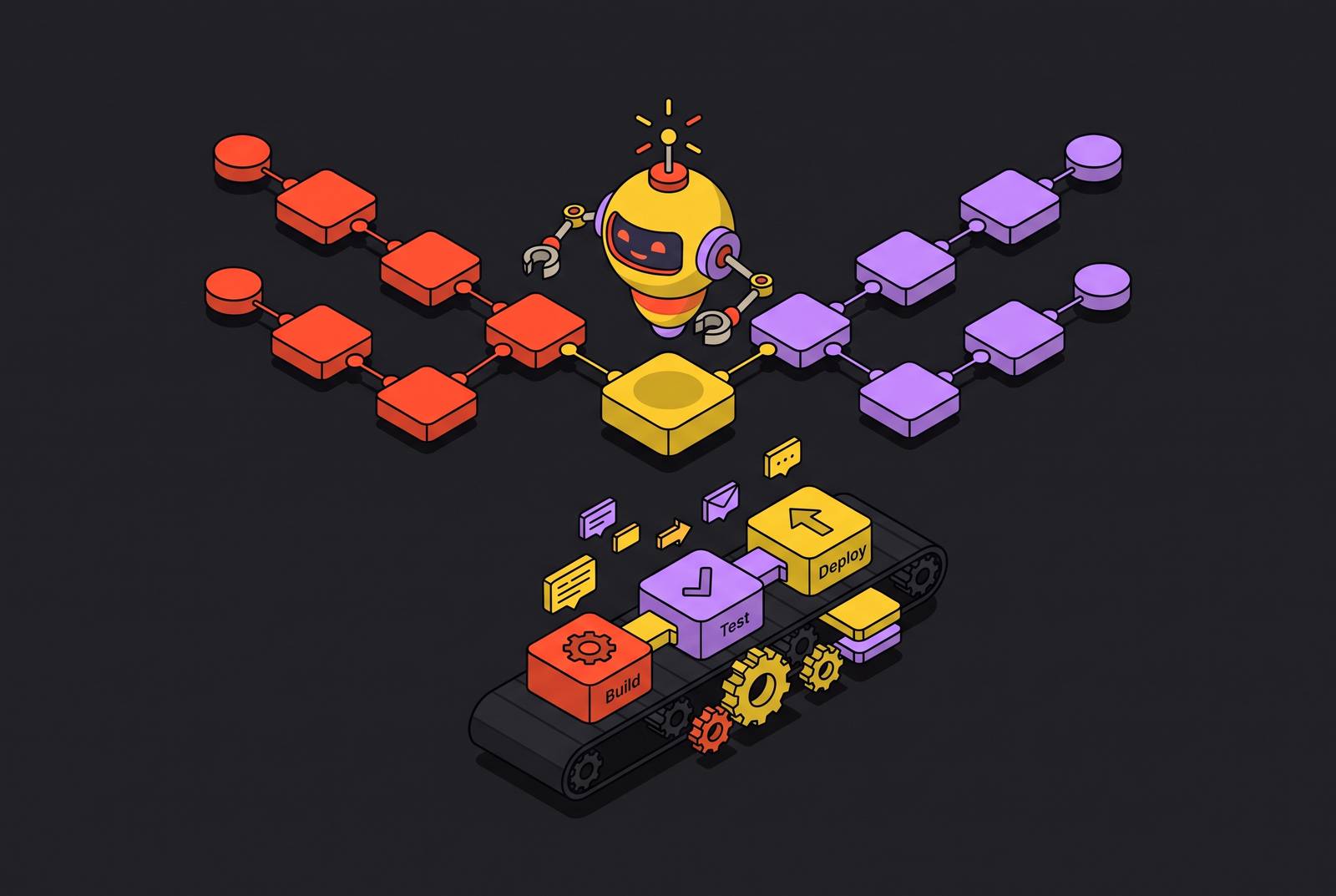
Conflict is frequent and partly invisible to git itself, so a smarter ordering of work, not a smarter resolution algorithm, is the first useful fix. A merge queue serializes the path into the target branch: it ensures every pull request gets validated against the current tip of the branch before it merges, and it stops one unresolved conflict from quietly becoming the baseline that the next PR gets tested against.
The mechanism is straightforward once you see what it is protecting against. A merge queue takes pending pull requests, lines them up, checks each one against the current state of the target branch, re-runs whatever checks are required, and only lets a merge through once those checks pass. GitHub's Merge Queue implements this inside branch-protection rules or repository rulesets, creates dedicated refs for each queued commit, and supports speculative batching through build concurrency settings, along with configurable minimum and maximum group sizes that control how many validated pull requests get merged to the base branch at once. GitLab's Merge Trains work on a related principle: each merge request is combined with the merged result of whatever is ahead of it in the train, the pipeline runs against that combination, and if a request fails, GitLab removes it from the train and restarts pipelines for everything queued behind it, which confines the damage from one bad merge to that one position in the train rather than letting it propagate.
None of this makes conflicts disappear. What it removes is the specific failure mode in which multiple unvalidated conflicts pile up quietly and then surface all at once in a batch, exhausting whoever has to untangle them in a high-throughput agentic repository. There is a real trade-off inside the queue design itself: speculative batching trades queue latency against CI throughput, since smaller batches catch conflicts earlier at the cost of running CI more often, while larger batches cut down on CI runs per pull request but widen the blast radius whenever a batch does fail.
One project shows what queue-first discipline looks like when you apply it specifically to agents rather than humans. The chidionyema/crew project, documented as early as September 4, 2026, sandboxes its agents so that they hand in diffs only and make no git writes or file edits outside that sandbox. As of September 30, 2026, the rulesets meant to enforce this had not yet been installed, but the design calls for a rule requiring a pull request, passage through the merge queue, and a successful CI run, with no bypass actors permitted, not even admins. That last detail carries real weight for agentic pipelines specifically: an agent, unlike a human maintainer under time pressure, has no reason not to take a shortcut around queue discipline if one exists, and doing so would quietly undo the serialization the whole queue was built to guarantee.
Agent state machines and worktree isolation as upstream defences against conflicts entering the queue
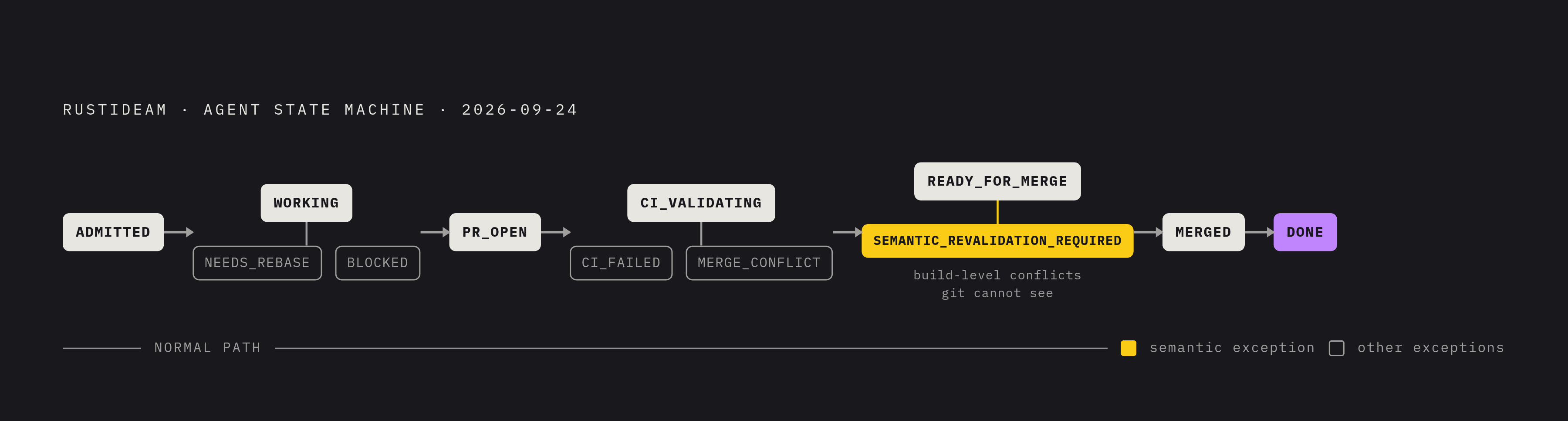
Queue discipline handles conflict at the moment of integration, but the more valuable fix happens earlier, by structuring how agents work so that fewer conflicts get generated in the first place. Two mechanisms do this: isolating each agent's working files, and giving each agent an explicit, machine-readable state that tracks exactly where it sits in the merge lifecycle.
Git's worktree feature gives each agent its own working directory and its own index, but every agent still shares one underlying object database, so conflicts get deferred to deliberate merge points instead of surfacing mid-execution. Codex CLI's /agent command lets a user switch between and inspect active agent threads, but by default, sub-agents share a single workspace, and worktree isolation has to be turned on explicitly through an isolation: worktree setting rather than happening automatically. That default matters: a team running several agents in Codex CLI without configuring isolation is, by default, running them in a shared workspace where collisions are more likely, not less. If you merge sequentially, so each completed branch merges into main and every remaining branch then rebases onto that new main before continuing, surprise conflicts stay confined to one branch at a time, and you don't end up with every running agent contending with every other one at once.
The second mechanism is explicit state modeling, and the balamacab/RustIDEAM project, documented September 24, 2026, offers a concrete version of it. The project defines a normal-path sequence of machine-visible states an agent passes through: ADMITTED, WORKING, PR_OPEN, CI_VALIDATING, READY_FOR_MERGE, MERGED, DONE. Alongside that, it defines a set of exceptional states that an agent can land in when something goes wrong: NEEDS_REBASE, MERGE_CONFLICT, CI_FAILED, SEMANTIC_REVALIDATION_REQUIRED, and BLOCKED. What makes this design notable is the explicit acknowledgment that git's own textual conflict detection is not enough: semantic overlap between agents triggers a separate convergence validation stage, built specifically to catch the build-level and semantic layers of conflict that a plain git merge cannot see. Because every agent's position in this lifecycle is encoded as a named state rather than left implicit, the queue and the CI system can make routing decisions on their own, without a human having to interpret what an agent is doing from logs or guesswork.
Elastic's self-correcting monorepo pattern adds a rule that works alongside both the queue and the state machine: the moment an AI pushes a commit to a branch, the pipeline disables PR auto-merge for that branch through GitHub's GraphQL API, restarts the pipeline from the beginning, and only lets the agent re-engage if the new run fails.
The human role in agent-operated merge queues
None of this infrastructure is built to take humans out of the pipeline. It is built so that the time humans do spend goes toward the decisions that actually need a person: semantic contradictions between two pieces of agent-authored logic, architectural trade-offs about which approach should win, and the judgment calls about how much autonomy to grant a given agent in a given context. Mechanical conflict triage, by contrast, is exactly the kind of work a well-designed queue and state machine can absorb without a human in the loop.
The data on where the bottleneck currently sits makes the case. The SBES 2026 study found that humans are still committing the overwhelming majority of conflicting merge commits, and that is not because resolving those conflicts actually requires human judgment at that stage, it is because most pipelines have not yet been built to route conflicts to whichever handler, human or agent, is best suited to resolve them. The same study found an enormous spread in how often different agents resolve conflicts on their own, ranging from a fraction of a percent up to nearly 29.4% for the strongest-performing agent, and that spread means a single fixed policy, whether "always escalate to a human" or "always let the agent try first", wastes effort in one direction or the other depending on which agent is involved.
What a working routing policy looks like has already been sketched out in reference architecture for AI-augmented CI/CD. Within a defined permission boundary, an agent is allowed to retry failed steps, patch a flaky test, adjust resource requests, or roll back a canary deployment entirely on its own, and only when its confidence drops below a set threshold, or the action it wants to take exceeds what it is permitted to do, does it open a pull request with its recommended fix and page the on-call engineer, rather than sitting silently blocked. That is a genuine escalation contract: the agent resolves what it can resolve with real confidence, documents why, and hands off the rest to a human who gets full context rather than a bare notification that something failed.
Pulumi's framing of the underlying economics explains why this distinction matters beyond pipeline hygiene. Once agents are both writing code and reviewing it, the bottleneck in the system moves past the pull request itself, and the resource that stays scarce and expensive is engineering time, not CI minutes or PR count. What you should track in an agentic pipeline is human hours spent per unit of value delivered, not how many PRs move through the queue per day. An agent-operated merge queue earns its keep when it cuts the human-hours cost of conflicts that are genuinely textual or structural, since a state machine and a queue can classify and route those on their own, and it keeps human attention reserved for the semantic conflicts no mechanical system can classify.
Closing the feedback loop with production signals and transcript analysis
The infrastructure described so far catches conflicts at merge time and stops some of them from forming during agent execution, but neither layer tells you why the same kind of conflict keeps recurring across a codebase's history. Closing that gap requires feeding information back from production and from the agents' own reasoning into however agents are scoped and supervised going forward. If a semantic conflict reaches production despite passing CI, that is a signal that the review stage missed a logical contradiction between two agents' assumptions, and it should change how future work gets scoped to avoid the same overlap happening again. Transcripts of an agent's own reasoning during a merge conflict likewise show not just that a conflict happened but why the agent made the choices it made leading up to it, and a bare pass/fail CI result cannot give you that. Treating these as inputs to the state machine and routing policy, rather than as a one-time postmortem exercise, is what turns an agentic pipeline from one that merely survives conflict into one that reduces how often the same conflict pattern appears again.