Git Branching Strategy for Multi-Environment Agent Deployments
Isolate agent tasks with worktrees and branches to enforce environment promotion policy.
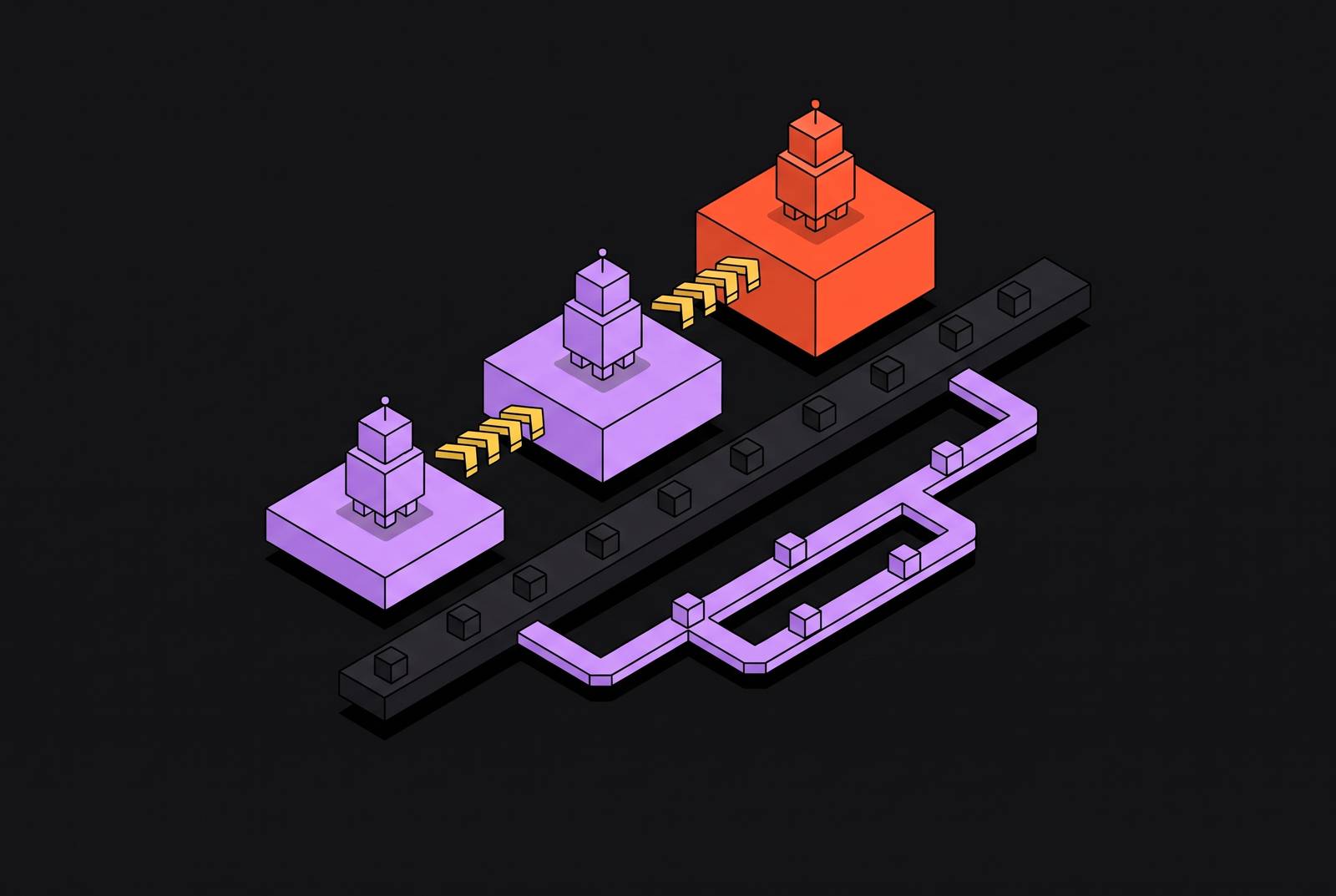
Agent-driven deployments across dev, staging, and production require a Git branching strategy enforced by the platform. The infrastructure must enforce task isolation, environment promotion, verification, and the order in which changes merge. The resulting design makes a branch more than a place to collect code. It becomes a controlled path from an agent task to an authorized production change.
Why human branching conventions break when agents drive deployments
Human Git workflows depend on authors who explain intent, take responsibility for changes, and produce work at a pace that reviewers can follow. Branches, pull requests, reviews, and blame make those expectations visible. Agents break the relationship between output and oversight. Their intent lives in a task specification outside the repository, while their commits arrive at machine speed and their output grows independently of human review capacity. A well-written PR description still leaves out the architectural reasoning.
Concurrent execution adds a separate failure mode. Two agents sharing a working tree can edit the same files without exposing the collision while they work. The repository may therefore contain changes whose authorship is visible but whose assumptions have already been invalidated by another task. Across environments, that uncertainty affects both code review and decisions about what to deploy. Contributor conventions cannot constrain this behavior because agents do not self-correct through the social pressure that keeps a human workflow coherent.
Worktree-per-task as the foundational isolation primitive
Git worktrees give parallel tasks separate working directories and branches while sharing one object store. The command git worktree add ../my-project-feature-a feature/add-auth creates a directory with its own checked-out branch. History, objects, and refs remain shared. This separates active edits without creating separate repositories. Conflicts move from silent overwrites during execution to detectable events when branches combine.
The platform’s allocation unit should be the task. Each task receives a branch and worktree, and an agent receives a task-scoped assignment to that worktree. If a task goes wrong, its worktree can be deleted and the task restarted from a clean base. Without that separation, concurrent execution invites file overwrites, contaminated context, and .git/index.lock contention that can stall agents until a human intervenes.
Separate filesystems can still share the same test infrastructure. Per-worktree environment files must also point agents at separate database files or instances so migrations and seed data cannot invalidate another task’s assumptions. Tasks can also compete for shared build caches. In practice, filesystem I/O and available reviewer bandwidth constrain useful parallelism before branch creation becomes the central problem.
Branch naming as load-bearing governance, not a cosmetic convention
An agent/ prefix gives policy machinery a filterable declaration of agent-authored work. Some teams use ai/ instead. The essential property is a consistent namespace that reviewers recognize before opening a diff and automation can select without interpreting its contents. The agent/* pattern supports branch protection, review routing, CI gate selection, and audit queries.
That selector is useful only when permissions support it. Platform rules must stop agents from committing directly to main, integration, or another shared base branch. Otherwise, machine-speed output can reach shared history before a gate runs. Commit metadata then extends provenance beyond the branch’s lifetime through a structured Co-Authored-By trailer naming the model and machine-readable fields for task ID, agent role, and verification results. These records make agent work queryable with git log --grep and give later blame investigations evidence that does not depend on an approver remembering the task.
The branch topology that enforces environment promotion as policy
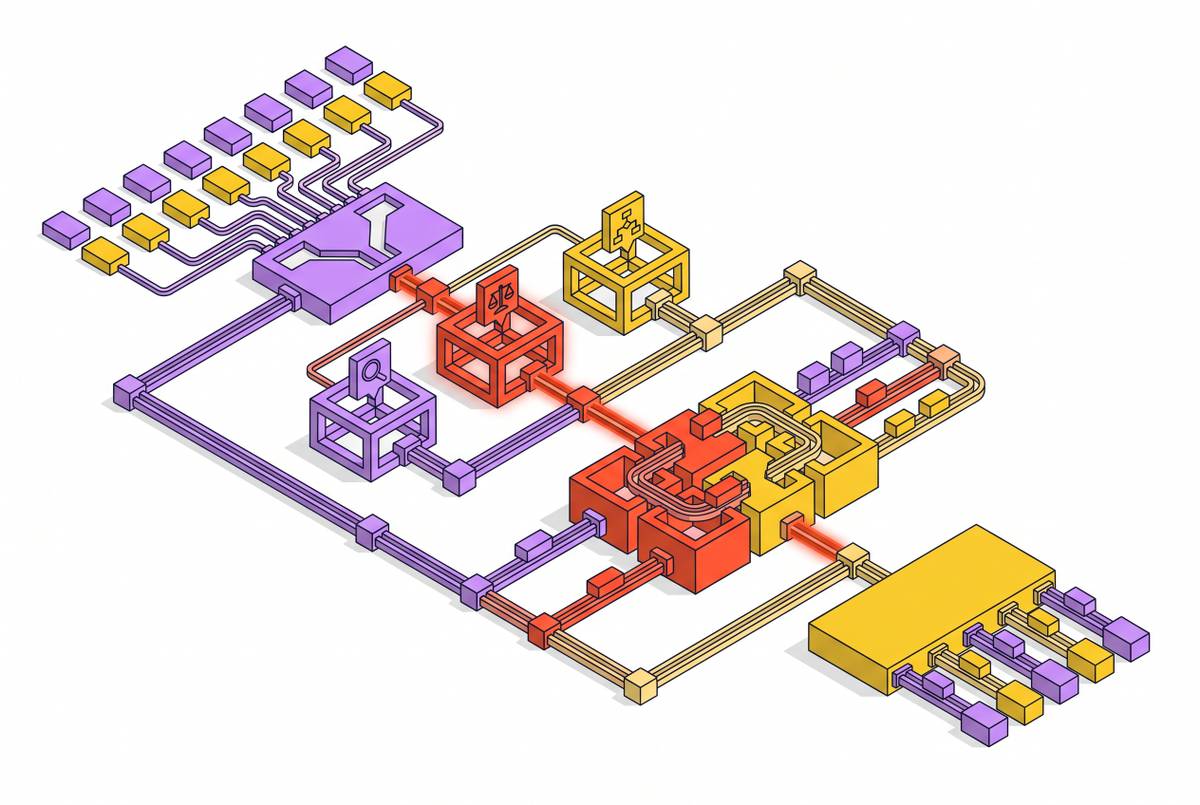
The promotion path runs from an agent task branch through integration to protected main. Task branches keep development work separate, integration is the supervised boundary before production, and main is the protected destination for production. Agent PRs may target integration only. They cannot target main or release branches directly, so the environment transition requires a governed merge.
Integration is also the point where changes become release-eligible through deeper verification. Its nightly suite covers integration, performance, DAST, chaos, and mutation testing before promotion. This gives staging a supervised body of changes rather than an arbitrary collection of individually approved tasks. The topology places a boundary between accepting development output and authorizing production delivery.
Hotfix is the explicit exception to that direction. It may move sideways into integration, release, and main, and that permission must be encoded. For continuous agent PR traffic, this integration-branch model sits between GitFlow’s heavier coordination and GitHub Flow’s looser path to production. Its purpose is not additional branch ceremony, but an environment boundary that agent throughput cannot bypass.
CI gate design for two kinds of change authors on the same pipeline
Namespace-aware CI checks human and agent changes in different ways while keeping them on the same delivery path. Agent-generated descriptions can summarize edits fluently while omitting architectural reasoning, and large generated diffs invite rubber-stamped review. That creates confidence without equivalent scrutiny. Selecting gates by branch prefix gives the platform a backstop without imposing the same verification cost on every human-authored PR.
The division is fast checks on task branches and the full nightly suite on integration. Integration, performance, DAST, chaos, and mutation tests are too expensive to repeat for every agent PR individually. Running them before promotion makes that expense a deliberate part of release eligibility. Passing a task gate therefore permits integration.
Security controls also belong at this shared layer. Prompt-injection guardrails and input/output filters cannot depend on each agent’s configuration if they are to govern every application repository. The hellodk architecture documents 11-gate security enforcement through a single hooks and policy repository consumed by application repositories.
Merge queue serialization when agent throughput saturates the base branch
Two PRs can pass CI against the same base commit and still fail when merged together. Once the first lands, the second PR’s green result is for an integration state that is already out of date. At high agent throughput, this is a routine ordering problem.
A merge queue validates each PR against the latest base and the PRs ahead of it. Temporary merge branches put changes in the order they are meant to enter integration before they land. GitLab’s native equivalent, merge trains, provides the same sequencing principle for merge requests. The platforms do this in different ways, but both require checks against an up-to-date base.
Each queued PR triggers checks on a temporary merge branch, while batching and concurrency settings can reduce how quickly resource consumption grows. Teams must track those workloads and provide the resources they need. An agentic queue can also find conflicts, triage CI failures, and manage the queue, so humans can make the decisions that need judgment while the queue handles routine upkeep.
GitOps delivery wiring and environment sync
GitOps makes the branch an authorization unit for environment changes. The sync policy for each environment must thus follow the promotion path, keeping development changes separate from the governed integration state used for staging, with protected main controlling what goes into production. A merge must only allow deployment to the environments its branch permits. Otherwise, delivery wiring would bypass the boundaries established in Git.
Git webhooks can bring ArgoCD’s merge-to-sync response from minutes to seconds by bypassing the wait for its default polling interval. At agent throughput, a multi-minute delay creates ambiguity about which change is running in staging. Faster notification shortens that wait while keeping promotion gates in place.
The governed scope extends beyond application code. In 2026, GitOps also encompasses cloud infrastructure, network configuration, security policies, and database schemas. Crossplane lets agents request infrastructure declaratively through Kubernetes objects, including a CompositePostgresInstance that triggers underlying cloud provisioning. Those requests can flow through the same promotion pipeline as application changes, while continuous reconciliation reduces divergence between the branch’s desired state and the environment’s actual state.
Agent identity, scoped credentials, and the audit trail the topology must produce
Agents must commit under separate bot identities, with a machine user or GitHub App in place of a human team member’s account. A branch prefix identifies the class of work. The authenticated identity establishes who performed it. Without that distinction, blame and audit records can attribute machine actions to people who did not execute them.
Credentials must be scoped per repository without admin rights or force-push permissions on shared branches. Agents may rebase their own task branches, while main, integration, and release stay protected and append-only. Production-touching agents also require a tight tool allowlist, approval tiers for write actions, idempotent retries, a maximum runtime, and a kill switch. These controls bound both authorized behavior and the means of stopping it.
The history must help teams find out what happened in an incident. Machine-readable trailers should make agent identity, task ID, branch name, verification results, and the human merge approval recoverable through git log. The provenance record must also connect the task to its authorization event. A production change is accountable only when the record explains both what the agent did and who permitted it to proceed.
The semantic conflict problem that filesystem isolation does not solve
Worktrees and merge queues do not establish that combined changes make sense. Agent A can rename a function that Agent B still references, and separate directories cannot reveal the contradiction while both tasks proceed. More difficult contradictions can survive compilation and linting, then fail at runtime. Mechanical isolation is not semantic compatibility.
Git flags changes to the same lines directly, while duplicated implementations require cross-branch comparison to expose architectural fragmentation. Semantic contradictions can pass automated checks altogether. A queue tests the intended integration order, but its value still depends on what those tests can detect.
Task decomposition by module or layer reduces collisions before execution. Separating schema, API, and UI work gives parallel tasks clearer boundaries, much as it does for human developers who cannot communicate in real time. A coordinator/specialist/verifier architecture adds a designated agent or model that checks specialist output against the living specification before merge. That can expose drift the authoring agent rationalizes, but it does not turn branch mechanics into proof of correctness. Even with better naming, semantic verification needs human judgment or verification infrastructure built for that purpose.
Assembling the policy stack and enforcing it
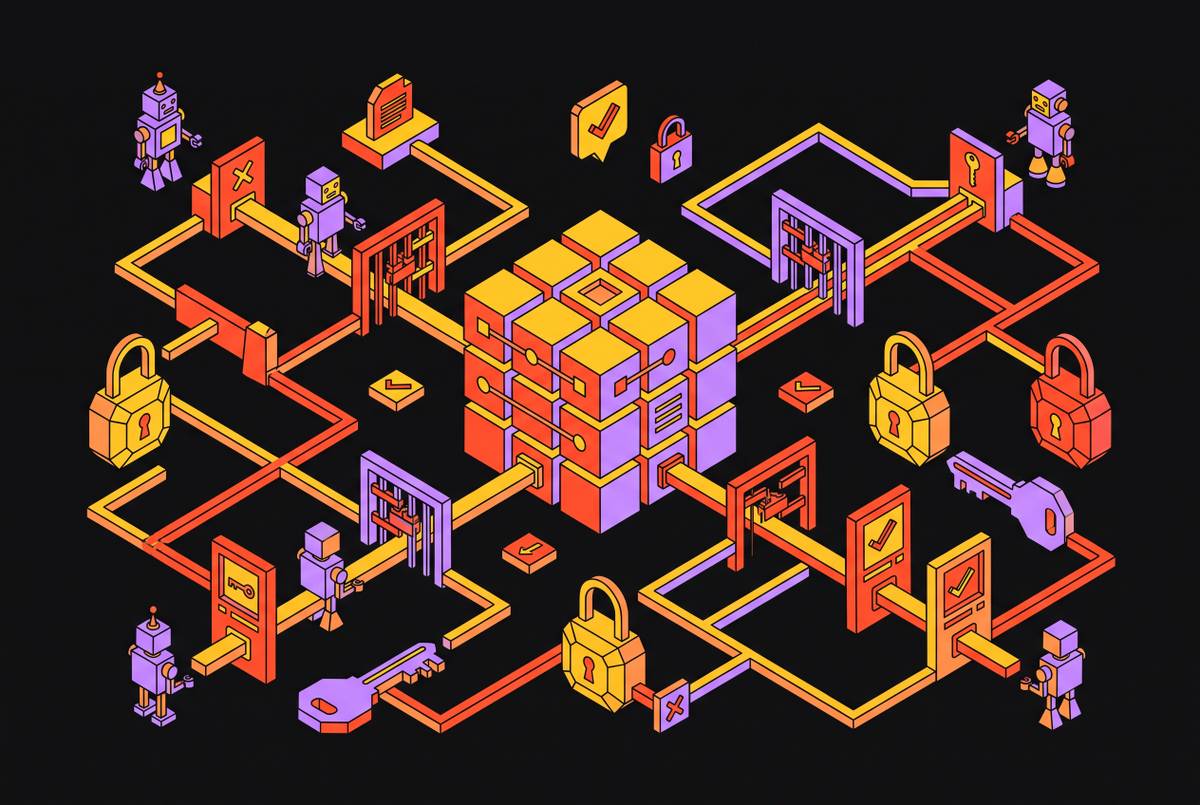
Platform engineers must assemble these controls as a connected enforcement layer. Branch protection supplies no-direct-push rules for main and integration, squash-only merges, and required signed commits. Namespace-aware CI supplies lighter task gates and full nightly integration verification, while bot identities and repository-scoped credentials restrict who can act. Merge serialization then protects those verification results from stale-base races. A gap between these controls is still a path around policy.
A shared hooks and policy repository makes that layer consistent across application repositories, including Terraform and Helm. It centralizes AI guardrails, bypass reporting, and branch protection rather than leaving each team to reconstruct the rules. Teams can compose focused components for agent-aware queue operation, code storage, and transcript analysis.
Rollback provides a concrete test of the design. Squash-only main history and immutable signed tagged release images allow the previous signed tag to be redeployed, with every production commit mapped to a PR, scan set, build, and approval event. The broader acceptance test is whether a human can trace any production state to an agent task, verification result, and authorization decision in under five minutes. If that trace fails, the next platform task is to close the provenance gap.