GitHub Sync Architecture for High-Frequency Agent Commits
Agents expose four silent failures in sync layers built for human commit cadence.

When AI agents generate commits at machine speed across parallel worktrees, the sync layer that connects local state to GitHub becomes the binding constraint on how fast a team can actually ship. The architectures that manage this connection today were built for a workflow where one developer works one branch at a time, and that assumption no longer holds. A single developer directing several agents across parallel worktrees can now generate pull request volume that has nothing to do with headcount, but the ref update path, the merge queue, and the sync logic underneath them were never built to absorb that kind of traffic. A June 2026 study of new GitHub projects found coding-agent adoption more than twice as high as the prior baseline, with a markedly more intensive share of AI-assisted commits, confirming that this shift in commit behavior is already here. The sync layer's failures under this load aren't random. You can trace them back to specific assumptions baked into tools designed for human cadence, and they break in predictable, avoidable ways.
The four properties human-paced sync architectures assume - and agents break
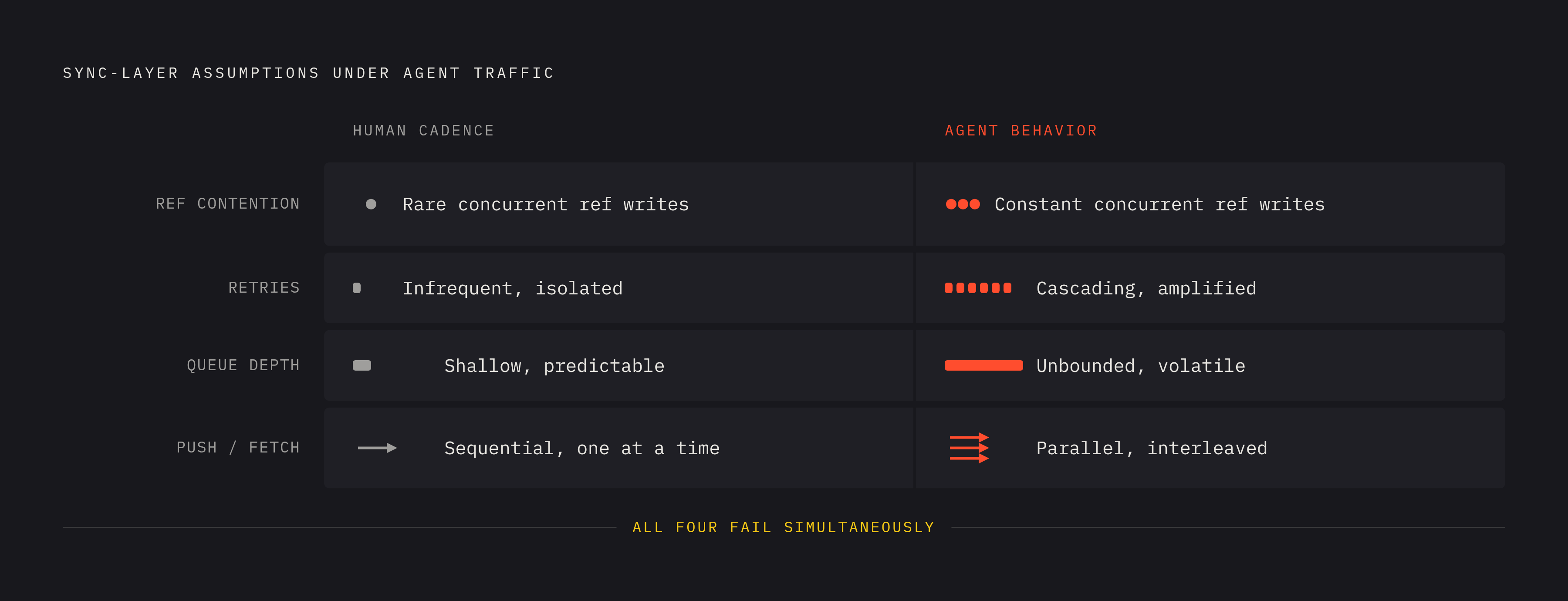
Sync architectures built for human teams rest on four assumptions about commit traffic, and each one was reasonable when a human sat behind every commit. Agent workflows violate all four because the traffic pattern agents generate looks nothing like the one these systems were designed to handle. The four assumptions are low ref contention, infrequent retries, bounded queue depth, and sequential push and fetch behavior.
Low ref contention holds in human teams because two people rarely try to update the same branch pointer at the same moment. Parallel agents working adjacent branches do this constantly, and the architecture's response to that contention produces either a clean retry or a silent failure. When a ref update isn't atomic, contention doesn't produce an error message. It produces a lost update: one agent's commit silently overwrites another's, the losing agent keeps working from a base that no longer reflects reality, and the resulting pull request arrives already in conflict with code that has already merged.
Infrequent retries is the second assumption, and it collapses just as fast under agent behavior. When a human hits a failed CI run, they read the error, and they fix the underlying problem before they try again. An agent instructed to get a pull request merged treats a retry as default behavior, re-queuing the same change and triggering a full CI run each time. At agent frequency, that retry loop stops looking like persistence, and it starts to look like a denial-of-service pattern aimed at the team's own infrastructure. The cost compounds further inside a batched merge queue, where one agent's failing submission can eject an entire batch, so every other pull request in that batch has to re-queue, and a single bad retry becomes a tax on the whole team's throughput.
Bounded queue depth is the third assumption, and it fails for a more mechanical reason: CI pipelines validate a fixed number of changes per day no matter how many more arrive. If a pipeline has a fixed end-to-end duration, it has a hard ceiling on validated merges, and agent-generated pull request volume can push arrival rates past that ceiling while headcount stays exactly where it was.
Sequential push and fetch patterns round out the list. Human commit activity is naturally spaced by thinking time between one push and the next. Agents push the moment a task finishes and fetch only when a new task needs a base, producing bursts that arrive in clusters rather than a steady trickle, and a sync layer built around a steady trickle has no good way to absorb a cluster.
What the conflict resolution timing window looks like at agent commit rates
Conflict resolution has to happen before a merge is attempted, because the gap between a clean rebase and a conflicting push collapses to seconds once agents are the ones pushing. In a human workflow, the time between rebasing a branch and pushing it is measured in minutes of attention spent reading code and thinking about edge cases. An agent closes that same gap in milliseconds, so any other agent pushing to the same target branch inside that window creates a conflict with no signal to either party that the other one was even working.
Catching that conflict early requires the sync layer to hold a consistent view of the target branch at the moment a push gets enqueued, not at the moment the agent started its task, which may already be many commits behind. The cost difference between catching a conflict early and catching it late is substantial: a conflict caught at queue entry means the agent gets handed a clean rebase target and reruns against it at modest cost. A conflict caught at merge time ejects the pull request from the queue and can eject the entire batch behind it, multiplying the cost of one missed signal by however many pull requests were riding along.
That cost asymmetry sets the real requirement: the sync layer needs a conflict-detection clock running at the speed of the queue. Automated rebase has to be a routine, first-class operation inside the sync layer, not a fallback that only triggers after a merge has already failed.
Why ref update atomicity is not optional when multiple agents share a target branch
When several agents push to a shared target branch without atomic ref updates, the failure that results is the worst kind: invisible until it isn't. A lost update doesn't throw an error. It produces a divergent history that sits quietly until a merge, a downstream check, or a human notices a commit that should exist and doesn't.
If a ref update is atomic, the ref moves completely from one state to the next, so no half-finished state is ever visible to another reader or writer. Think of it the way a bank treats a balance transfer: the money either moves in full or it doesn't move at all, and nobody is ever shown an account that's been debited without the matching credit landing somewhere. A non-atomic push path, including a naive optimistic push with no compare-and-swap check on the ref, allows two agents to both read the ref at the same commit, both produce their own next commit from that point, and both push successfully, with one commit silently overwriting the other and no error returned to either agent.
A lost update is structurally worse than a conflict, because a conflict gets detected and retried while a lost update just disappears. Atomicity matters on the fetch side too: an agent pulling a base for a new task needs a consistent snapshot of the target branch, not a partial view caught mid-write by another agent's in-flight push. The sync layer handling agent workloads has to enforce compare-and-swap semantics at the ref level, so every push is a conditional update that fails loudly when it collides with a concurrent write.
Queue depth management when CI duration is the fixed ceiling
Once ref updates are atomic and conflicts get caught early, the remaining constraint is throughput, and that constraint is set by CI duration rather than by how deep a queue can theoretically grow. Because CI duration stays fixed in the short term, you have to manage agent commit throughput mainly through queue depth strategy if you don't want to spend more on infrastructure. A pipeline with a given end-to-end runtime can only validate so many merge candidates per day, and adding agents to a team's workflow raises the arrival rate of changes without raising the rate at which CI can process them.
Batching is the standard answer to that mismatch: run CI once against a group of pull requests instead of once per request, and the effective service rate multiplies by the size of the batch. That multiplier only holds when the batch passes. A failing batch ejects every member back into the queue, and depending on the failure rate, that can burn more total CI time than simply running each change one at a time would have.
Agents fail in a way that has no real counterpart on human teams. When a human sees a failed build, they read the error and fix the code before they try again. If an agent retries a failed pull request, it often re-enters the queue at full depth, consumes a CI run on a change that's still broken, and pushes every other entry in the queue back in line behind it.
The fix for this has to live at the queue layer rather than the agent layer, since an individual agent may have no visibility into how deep the queue already is. So you need per-agent retry budgets and back-off policies enforced centrally; you can't leave that to each agent's own judgment about when to try again.
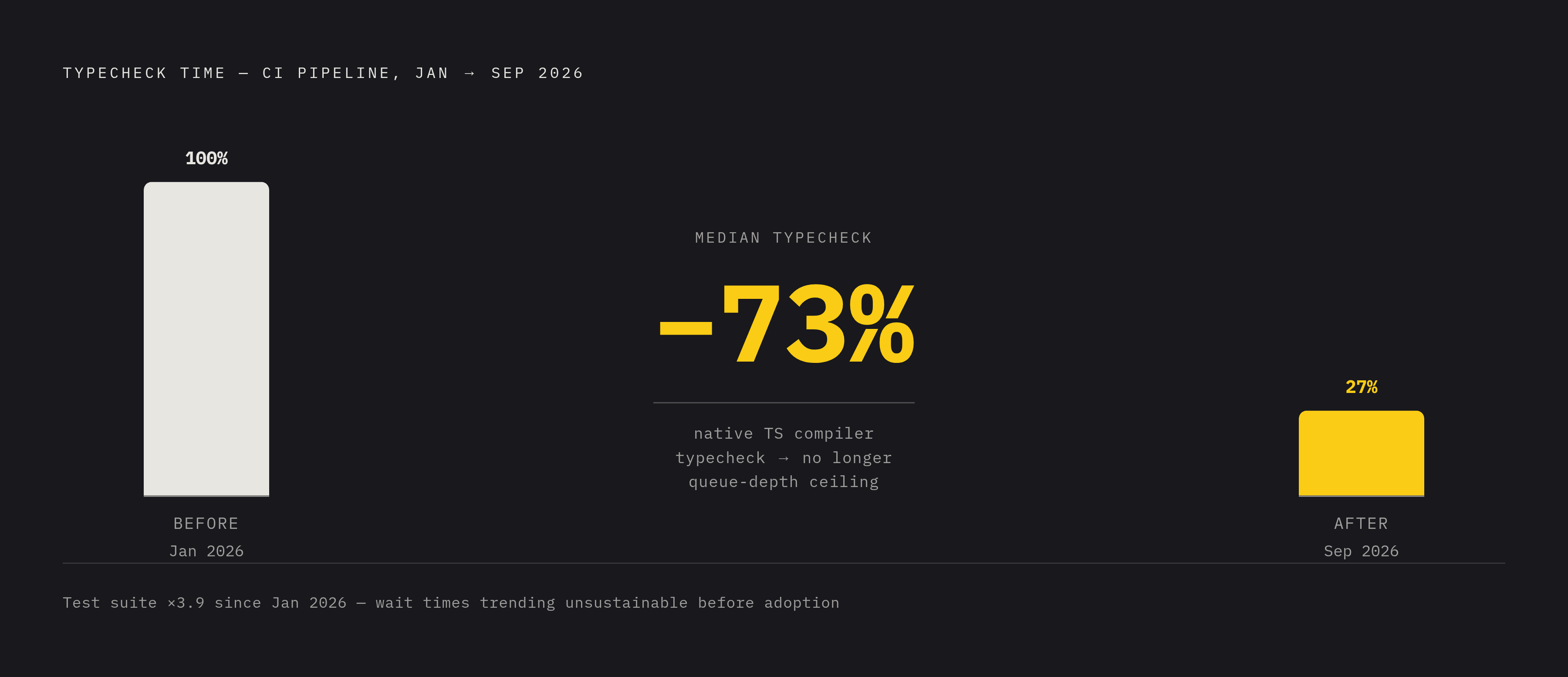
CI speed itself becomes a strategic lever in this picture. If you take CI duration from a level where merge queues waste more time than they save down to a level where batching pays off, you're optimizing queue depth as much as CI, and when teams cut CI time they unlock a higher effective queue depth without raising the risk of batch failure. Linear's experience in September 2026 shows the mechanism clearly: its test suite had grown nearly fourfold since January 2026 as agents wrote most of the new tests, and without intervention, CI wait times were on track to climb to a point where queue throughput stopped being sustainable. Linear's published 2026 results show that adopting the native TypeScript compiler cut median typecheck time by 73%, removing typecheck time as the binding constraint on the whole pipeline.
Fetch and push patterns that match agent burst behavior rather than human cadence
A sync architecture that serializes every fetch and push for safety's sake will become the bottleneck before any other part of the system does, because agents don't spread their activity across the workday the way humans do. They complete tasks and push in bursts, often with several agents finishing overlapping work inside the same narrow window.
Human cadence naturally rate-limits itself: a developer fetches once at the start of a task, pushes once at the end, and the gap between those two events is minutes long because there's a person thinking in between. Agents fetch at task start and push at task completion with no thinking gap at all, and when many agents complete tasks in the same window, that produces a burst that a serialized push path simply queues up and waits on. The burst overwhelms the serialized push path at the sync layer itself rather than inside the merge queue, so it raises latency instead of queue depth, and it stays invisible to any monitoring built to watch the queue.
The fix is to parallelize push handling with compare-and-swap checks at the ref level, so pushes that don't actually conflict proceed concurrently and only genuinely colliding pushes get serialized against each other. Fetch patterns deserve the same scrutiny: if an agent fetched its base at task start, it may be pushing against a base that's drifted many commits stale by the time the task finishes on a fast-moving team. A well-built sync layer calculates that staleness delta at push time, so either the agent or the queue can decide whether a rebase is needed before the change goes in line.
This is where an API-first, event-driven approach to fetching, pulling a fresh base snapshot on demand instead of cloning or pulling the full repository on a fixed schedule, fits agent behavior better than a periodic pull model built for human cadence. It cuts both the latency and the bandwidth cost of the fetch step, treating agent burst traffic as the normal case.
What a Viable GitHub Sync Layer Looks Like
A sync layer built to handle agent commit velocity needs all four pieces working together: pre-merge conflict detection, atomic ref updates, queue-aware retry budgeting, and push parallelism that tolerates bursts. Teams that get all four right see throughput and merge latency improvements that validate the architecture as a whole, not just each piece in isolation.
OpenAI's approach to this problem illustrates the point well. Its system classifies actions by risk, letting most work proceed inside a sandbox without interruption while routing only the actions that cross a sandbox boundary to an automated reviewer for approval or denial. That's an architectural decision about how the queue itself is structured, and it shows that queue design encodes a team's actual risk tolerance.
A newer architectural pattern has emerged alongside this: the AI-native forge, where an intermediate layer sits between the agent and GitHub, with the agent pushing to the forge and the forge managing sync with GitHub as the system of record. Cursor's Origin, launched in August 2026 with bidirectional GitHub sync, is an example of this pattern. The value of the layer is in what it separates: agent-speed operations like branch creation, commit, diff, and rollback happen on one side, while human-speed operations like pull request review and merge happen on the other, each operating at the cadence that actually suits it.
An API-first Git filesystem sits underneath that separation: branches, commits, diffs, rollback, and bidirectional sync with GitHub repositories, all driven over an API. Agents interact with the API, the sync layer handles the GitHub protocol, and the ref layer enforces atomicity, so no agent has to implement that guarantee itself.
Not every team needs all four pieces at once. If you run a small number of agents against a slow CI pipeline, you get the most benefit from queue depth management first. If you run many agents in parallel against shared branches, you get the most benefit from atomic ref updates first. Taking on these pieces individually instead of forcing a full platform replacement before you see any benefit matches how teams actually adopt infrastructure changes in practice.
The architectural debt that high queue throughput does not address
Solving the sync layer's throughput problem doesn't touch the quality and review capacity problems waiting on the other side of it. Once the queue stops limiting throughput, code quality and the team's capacity to review that code become the next binding constraint, and no amount of sync architecture resolves that on its own.
Research into follow-up fixes and commit authorship on agent-generated pull requests shows that agent-authored changes have different merge rates and different follow-up patterns than human-authored ones. The sync layer has no visibility into that distinction; it treats every validly formed push the same way regardless of who or what wrote it. Review systems have to account for it, and building a sync architecture that can absorb agent commit velocity is a necessary step toward a sustainable agent-driven workflow, alongside the review discipline that has to sit on top of it.