Git Performance Bottlenecks in Agentic Development Workflows
Agents committing code at machine speed expose infrastructure limits designed for human developers.
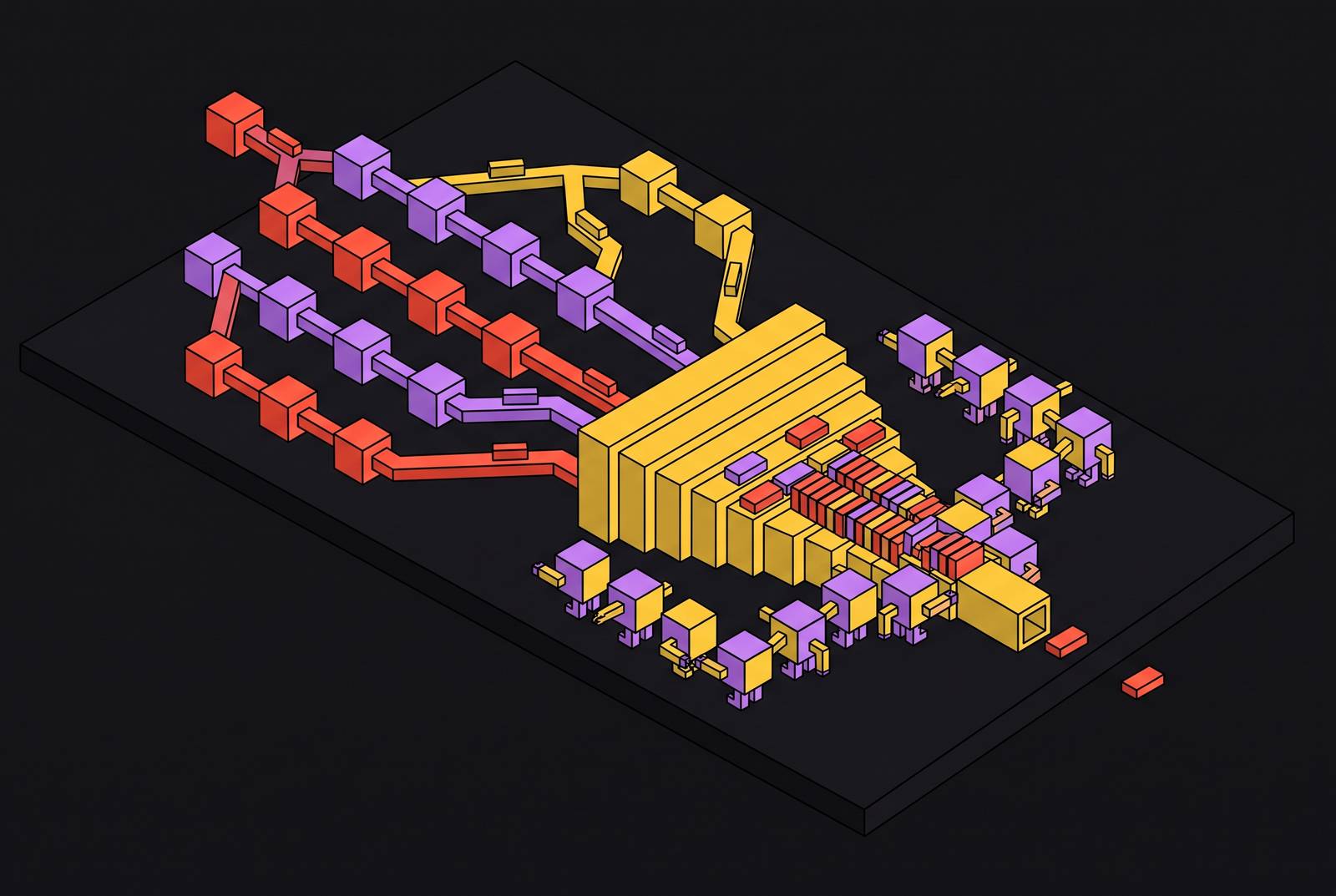
Git performance bottlenecks in agentic development workflows reveal a structural mismatch between human-paced infrastructure and machine-paced work. The constraint is how storage, validation, context management, and governance together handle the traffic resulting from an agent's code production. Engineering around that mismatch requires separating capacities that older designs couple, rather than accelerating one stage and moving the queue to the next.
Why agent-scale commit volume is structurally different from human commit volume
A human developer produces a small number of commits and CI runs per day, while an agent in a tight loop may commit or checkpoint after nearly every action. GitHub Engineering reports that pushes grew from 0.69 billion to 3.35 billion per month year over year, nearly a fivefold increase. In September alone, developers and agents made more than five times as many commits as a year earlier. Pull request merge volume grew to nearly four times its prior-year level, while GitHub Actions ran more than four times as many jobs in September. These figures establish a change in infrastructure demand.
The character of that demand matters as much as its volume. Agent-assisted commits are larger than human-only commits and contain a high proportion of feature and bug-fix changes, so each push carries more diff weight. Tight execution loops also turn intermittent activity into sustained write pressure. An agent waiting for each checkpoint cannot outrun the latency of that operation. GitHub Engineering identifies commit turnaround as a per-agent bottleneck, with delays a human would not notice becoming the limit on agent speed.
The Spokes architecture makes the underlying tradeoff concrete. It stores full repository copies on several fileservers and uses a quorum-based three-phase commit to guarantee consistency on every push. Every replica participates in every write, so completion depends on acknowledgement from the slowest replica in the set. Adding replicas to take on read traffic adds write overhead too, so read capacity cannot grow on its own. Losing a replica reduces read capacity, while losing quorum halts writes entirely.
This coupling served human commit cadences but places durability and throughput in tension under sustained agent traffic. Repository maintenance adds another cost because new writes increase the work of compacting repository data and cleaning up unreachable objects. Fast clones make reads faster, but the work that comes with writes remains. GitHub Engineering states the required design principle as separating durability from scale. Read capacity must be able to grow without adding write overhead, and writes must keep going when a replica is lost.
How monorepos and large repositories amplify every one of these pressure points
Repository size multiplies the cost of the same traffic. Operations including mergeability evaluation, diff rendering, search indexing, background checks, and API payload handling become more expensive as repositories grow. Some expensive operations scale super-linearly, so the penalty is not simply proportional to the amount of code. Concurrent agents working in a monorepo also converge on a shared reference point, with their pushes contending on the same main branch tip. The result combines more frequent writes with more expensive work around each write.
That combination makes checkpoint latency especially costly in large repositories. Each agent repeats an operation whose cost rises with the repository, while other agents sustain pressure on the same architecture. Khelifi et al. studied recurring repository automations triggered by schedules and repository events. Those workflows create sustained, predictable activity. Predictability does not remove the constraint because a quorum-based write path still has to absorb the continuing load.
Why the merge queue becomes the next bottleneck once push latency is addressed
Faster pushes allow changes to reach the landing process sooner, but they do not make that process validate changes faster. Merge throughput depends on how many candidate states of main CI can validate per hour. That rate depends on how long the test suite takes, runner capacity, flake rate, and how the queue works. None improves automatically when storage latency falls. Code generation can therefore become the cheapest part of shipping software while code landing remains the limiting step.
Parallel agent work sharpens this distinction because pull request volume no longer tracks developer headcount. A single developer can direct multiple agents in parallel worktrees, producing work concurrently that the queue must reconcile against a changing main branch. Each pull request still requires validation against the current state before merging. If main changes while a pull request waits, CI must run again. Queue mechanics built around human typing speed serialize the output of parallel producers, creating a constraint that additional write capacity cannot remove.
AI-generated maintenance changes, including dependency updates, config changes, and test scaffolding, can flood the queue and delay human feature work. Khelifi et al. found that recurring agentic workflow files are still actively maintained, with a large share being updated months after they were created. Their continuing maintenance means the traffic they generate is not merely an initial burst. A queue built for this workload must use traffic classes as well as order, process stacks together, and keep agent maintenance traffic separate from human feature traffic.
How agent context management and commit discipline interact with Git throughput
Failed attempts, redundant tool calls, and confused multi-turn sessions can all produce checkpoints that consume Git capacity without advancing the task. The quality of the context affects how often an agent gets the work right and how much work the infrastructure must do to get a change that advances the task. An agent that loses the thread can give poor answers and need more iterations. Its additional iterations can become additional commits and queue entries.
Kapetanovic et al. at Infobip describe these failure modes in A Phased Workflow for Operating LLM-Based Coding Agents. They cite Hong et al., 2025, on performance degradation with input length and report a 39% average performance drop in multi-turn settings. They also describe how irrelevant context reduces accuracy even when the correct answer is present. The four strategies they describe, namely write, select, compress, and isolate, target the failed or confused iterations that produce low-signal commits.
The instructions for recurring work need the same care. Khelifi et al. found that agentic workflow files extend well beyond short prompts and contain code blocks in a majority of cases. These files are operational specifications whose quality shapes repeated repository activity. For platform engineers, trimming bloated skill sets and tightening context management in agent harnesses can reduce commit noise before it reaches storage or validation.
What the gap between benchmark performance and real-world delivery throughput reveals
FeatureBench evaluates end-to-end, feature-level development using tasks derived from code histories spanning multiple commits and pull requests. It finds that even capable models succeed on a small fraction of these tasks. Earlier benchmarks concentrated on bug fixes within a single pull request, leaving a narrower view of the operations required for delivery.
Feature-level work requires an agent to keep state consistent across commits and branch states. That is also where context management and Git throughput interact most closely. As the agent works through the repository, it must keep track of why earlier changes were made and how each edit fits with them. Multi-commit, multi-PR tasks can show where an agent falls short in ways that a single-PR task may not. A model's ability to generate a correct local change consequently says less about its ability to complete the full sequence.
An agent that cannot finish a feature in one session may restart, re-plan, and re-commit, multiplying Git operations without increasing the delivery rate. High push latency and serialized validation add infrastructure friction to those additional attempts. FeatureBench identifies the task type where maintaining state is difficult and repeated repository operations are central. Better models may reduce failed attempts without changing the storage and queue mechanics every attempt must traverse. Raw capability is therefore not sufficient evidence that the delivery system can sustain agent-scale work.
Why faster pipelines alone relocate the bottleneck rather than removing it
Faster storage and larger CI fleets are necessary responses to rising demand. They reduce real constraints on writes and validation, and those improvements matter even when another limit becomes visible afterward. The mistake is to treat faster passage through those stages as equivalent to faster delivery through the entire system. Once changes arrive more quickly at review, branch protections and required checks still govern whether they can land.
Security, quality, and test-coverage agents running as required merge checks introduce another fleet with its own cost, latency, and failure modes. Automated reviewers can also share blind spots with the agents that generated the code, creating a correlated failure mode that human review does not share. Review capacity therefore cannot be understood only as the number of checks running in parallel. The design must account for what those checks can miss as well as how long they take.
The architectural response is to distinguish interactive, batch, and agent traffic while allowing governance controls to scale conditionally with volume. A flat policy applied to all pull requests ignores differences in origin and risk, just as a single queue ignores differences in urgency and purpose. Conditional handling does not mean removing branch protections or required reviews. GitHub Engineering's principle of preserving the controls teams already operate on applies here as directly as it does to storage changes. Speed must be built around governance, with each layer handling its own constraint without defeating the safeguards of the next.
What a purpose-built infrastructure stack for agent-scale Git operations looks like
A purpose-built stack starts with storage designed for cloud-native agents. High-performance storage needs sync characteristics matched to concurrent agent workloads so that it addresses fan-out reads and sustained writes together. That requirement is distinct from providing general-purpose version control. Separating read scale from write overhead gives concurrent agents room to operate without making each checkpoint slower as read capacity grows. It also keeps durability from acting as the same mechanism that caps throughput.
Above storage, the merge queue needs explicit traffic classes for heterogeneous work. Agent maintenance pull requests can pass through expedited agent-only review while feature pull requests remain subject to human judgment. This separation must preserve the branch protections and required checks appropriate to the work. Stack-aware processing addresses related changes together, while class-aware routing prevents recurring maintenance from displacing feature delivery. These functions belong in the queue's design.
The broader pattern is composable because human developer experience, agent commit throughput, queue intelligence, and governance compliance impose different demands. Purpose-built components allow each layer to address its own workload without forcing one platform design to optimize every concern simultaneously. Production signals, including CI failures, deploy outcomes, and exception rates, also need to feed directly into agent workflows. Those signals let agents self-correct with less speculative work, connecting infrastructure performance to delivery quality. The resulting system is judged by useful changes delivered under its controls.