Git Shallow Clone Strategies for Agent-Driven CI Workloads
Shallow clones cost more than full clones in agent-heavy pipelines with workspace caching.
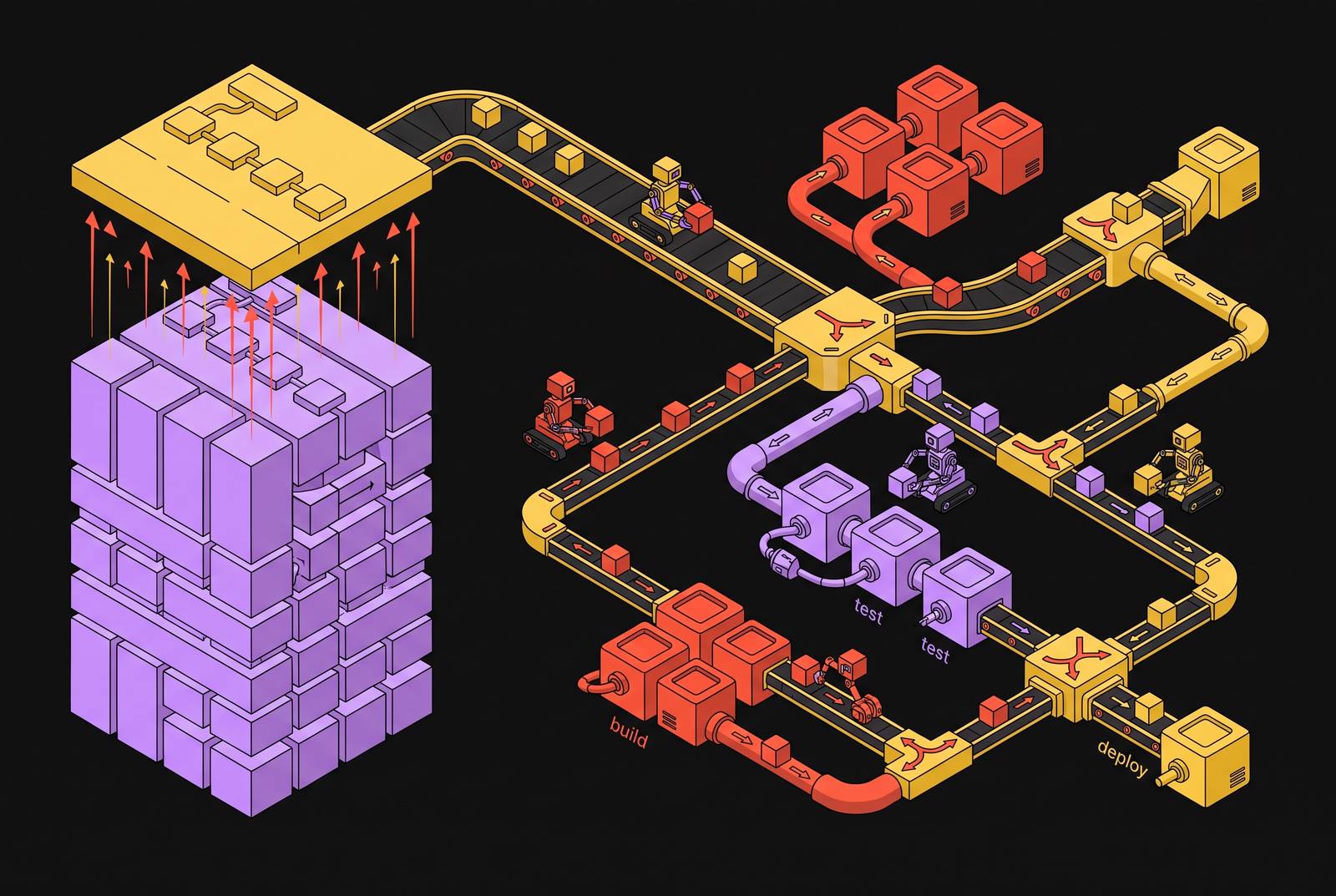
Agent-driven CI pipelines don't just run more clone operations than human-paced workflows do. A human-paced pipeline looks like one developer opening one pull request, one CI run firing, and the whole system measured in events per hour at most. The defaults that most teams inherit, shallow clone at depth 1, full single-branch checkouts, were tuned for exactly that cadence, where clone cost is a rounding error against the rest of the build.
Agent-driven CI breaks that model at the concurrency layer first. Merge queues that fire speculative CI runs make this worse, because each queue entry triggers its own clone-test-merge cycle, and a busy agent-fed queue can fire dozens of these cycles in just one hour.
The mismatch between this load and the defaults built for human pacing runs along three distinct axes. The second is frequency: agents re-clone or re-fetch into cached workspaces on every speculative merge or requeue event, making the incremental fetch the dominant expense. The third is history: agents that reason over commit history, run git blame, or operate inside GitOps reconciliation loops need more history than a depth-1 clone can ever supply, even though the canonical CI advice still assumes history is something nobody needs. Everything that follows traces back to these three axes, because each clone strategy available in Git addresses a different one of them, and the strategy that fails depends entirely on which axis the workload actually stresses.
How the four clone strategies cut along different axes
Git offers four distinct ways to avoid downloading an entire repository, and they are not variations on a single speed-versus-completeness trade-off. Each one cuts along a different axis, and understanding which axis a given strategy addresses is the only way to predict how it will fail when it meets a workload it wasn't built for.
A full clone transfers every commit, tree, and blob in the repository's history. It is self-contained from the moment it finishes: nothing further ever needs to be fetched to reconstruct any point in the project's past. Its cost is entirely front-loaded into the initial transfer, and every operation after that completes locally.
A shallow clone, invoked with --depth N, truncates history by writing a .git/shallow file that grafts a false root onto the commit graph. Performing a shallow fetch against a fully cloned repository costs roughly 25 times the server-side CPU of an ordinary fetch, because the server has to walk the real history to figure out what the client's fabricated history is missing, and that cost is visible on the Git host as unexplained latency rather than as a line item anyone can point to, since the builder running the job never sees it.
A blobless partial clone, --filter=blob:none, takes a different cut. It retains every commit and every tree object at clone time but withholds file contents, fetching blobs lazily as they're accessed. Commit history is intact: git log and pathspec filtering work fully offline. Reading the historical content of a file, through git blame or a direct checkout of an old revision, triggers an on-demand fetch from the remote. For most development workflows this is the strategy that gives the best balance: a fast initial clone, full history available locally, and blobs that get cached as they're touched. The exception is a checkout that touches a wide swath of files not yet present in the local cache. In that case, the sum of many small on-demand blob fetches can exceed the cost of having just cloned everything up front, which is a real risk in large monorepos with wide-touching changes.
A treeless partial clone, --filter=tree:0, goes further still, deferring tree objects as well as blobs. A build that clones and then checks out a specific commit SHA, which is what essentially every PaaS build does, spends whatever it saved at clone time immediately at checkout.
Sparse checkout, which you set with git sparse-checkout set, works on an entirely different axis from the three above. It limits which directories get written to disk and is orthogonal to both history depth and blob delivery, so it can be layered on top of any of the other three strategies. Its highest leverage case is a monorepo where an agent operates only within one service's subtree. Because depth, filter, and sparse-checkout control three independent dimensions, history, blob delivery, and directory population, a team can stack all three at once to get a narrowly scoped, history-appropriate, blob-efficient clone without reaching for the all-or-nothing trade-offs that shallow clones force.
How workspace caching flips the cost ordering of every strategy
The comparison most teams reach for, that shallow clones are the fastest option, is true only for a cold clone measured in isolation. Introduce workspace caching, which is the natural optimization for any high-frequency agent workload, and the ordering inverts: shallow clones become the most expensive strategy to run, and full or blobless clones become the cheaper ones.
The reason comes down to what actually dominates cost once a workspace persists across runs. Fetching into a shallow workspace triggers the same substantial server-CPU penalty described above, and it triggers it on every single fetch, because the server has to reconcile the real commit graph against the client's grafted, incomplete view of history each time. That cost is paid on the Git host's CPU rather than on the builder, so it never appears as a line item in any individual build's timing.
Once a meaningful fraction of builds need real commit history, a shallow clone costs you more than a full clone, even before you add in the incremental fetch penalty, because you pay a tax on every fetch that the full clone simply does not owe, and there is a break-even point where this crossover happens. Agent workloads that fire many speculative CI runs per hour cross that threshold much faster than human-paced workflows do, since those might manage only a handful of runs across a whole day, so defaults tuned for human cadence stop making sense once agents take over the pipeline.
A full clone paired with a cached workspace pays its high cost exactly once, up front, and after that it fetches cheaply against a complete history on every subsequent run. That makes it the correct default whenever agent sessions are long-lived and the workspace persists across them. On the infrastructure side, GitLab's guidance on monorepo performance notes that a pack-objects cache holds packfile responses in memory, so it reduces server load for repeated clone and fetch requests, and this matters directly if your team runs its own Git infrastructure and absorbs the fetch volume that agent concurrency produces.
Matching strategy to the four agent workload patterns that appear in practice
Three workload characteristics determine the right clone strategy for any given agent pipeline: whether the workspace is cached between runs, whether the agent needs history beyond the current commit, and whether the agent is confined to a bounded directory subtree. Those three characteristics combine into four patterns that cover most agent-driven CI in practice, and each one has a clear best fit.
The first pattern is the stateless, ephemeral agent run: a fresh clone on every build, with no caching. This is typical of disposable sandbox agents, one-shot code-generation jobs, and security-isolated build environments that are torn down after a single use. The caveat is specific and important: any tooling that calls git describe, setuptools_scm, or an affected-graph calculator has to be disabled or routed around in this setup, because these tools fail silently. setuptools_scm, for instance, will report a garbage version string.
The second pattern is speculative merge queue CI, where a workspace is cached and re-fetched between queue entries. This pattern appears in merge queues running speculative CI against batched pull requests, where each queue entry fetches new commits into a workspace that already exists. Enabling the Gitaly pack-objects cache helps directly in this pattern, because many queue entries often touch the same underlying objects.
The third pattern is GitOps reconciliation agents: frequent fetches into a long-lived, history-aware workspace. Because the fetch frequency is so high, shallow-clone server-CPU cost becomes a real infrastructure expense rather than a minor inefficiency, so the best fit is a full clone paired with a persistent, long-lived cached workspace, with a blobless clone as the alternative when initial clone time is the binding constraint instead.
The fourth pattern is the monorepo agent scoped to a single service subtree, where directory boundaries determine the clone scope more than history depth does. These agents don't need files from sibling services, but their history needs inside their own subtree can vary. The best fit combines a blobless clone with sparse checkout scoped to the relevant subtree, preserving history for in-subtree operations while minimizing both blob and directory data. Because depth, filter, and sparse-checkout are orthogonal, a team that needs neither deep history nor cross-service blobs can combine --filter=blob:none with git sparse-checkout set <service-path> and get maximum reduction without any of the broken-history traps that come with shallow clones.
Server-side and infrastructure choices that shape how any clone strategy performs at agent scale
At the volume agent-driven CI produces, the bottleneck migrates from client-side download speed to server-side pack-object generation and reference resolution. That shift means infrastructure choices on the Git host side aren't optional extras, they're prerequisites for any clone strategy to behave the way its documentation suggests it should.
A pack-objects cache, available in self-hosted Git infrastructure such as Gitaly, maintains an in-memory cache of packfile responses. When multiple concurrent agent sessions request the same objects, the server serves the cached response instead of regenerating packfiles for each request individually. This has the highest payoff for teams running many stateless agent runs against the same repository on self-hosted infrastructure, and it matters less once workspace caching has already eliminated most repeat cold clones.
Bundle URIs address a related problem from a different angle. A bundle URI stores a pre-built Git bundle on a CDN, and a client fetches that bundle first before pulling only the delta from the Git remote itself. This bootstraps the object database faster and takes the heaviest pack-object work off the Git server. It's particularly effective for agent fleets distributed across geography, where network latency to the Git host compounds with server CPU load as a second bottleneck.
Reference hygiene is easy to overlook and expensive to ignore. Precomputing the commit graph with git commit-graph write --reachable --changed-paths caches reachability data and speeds up merge-base queries directly, which matters most in merge queue pipelines that compute merge bases repeatedly across many speculative runs.
Scheduled maintenance closes the loop. Running git maintenance start sets up background tasks, prefetching, garbage collection, commit-graph updates, and loose-object packing, that keep a repository's object store organized without anyone having to intervene manually. On repositories under heavy agent load, where many concurrent sessions create and discard objects constantly, this kind of automated maintenance prevents the object-store fragmentation that otherwise compounds fetch latency over time.
Some platform architectures eliminate the clone step itself for read-path agent operations, using direct source control APIs instead of a working copy on disk: if an agent never runs git clone, the depth flag is irrelevant, and the question for platform engineers shifts from which filter flag to choose to which platform model to build on. Code storage purpose-built for cloud agents, with performance characteristics designed around agent access patterns rather than inherited from human-first version control, removes the mismatch at the infrastructure level.
A decision framework for platform engineers choosing clone strategy deliberately
A deliberate, defensible clone strategy follows from answering three questions in sequence: whether workspaces are cached, whether agents need history, and whether agents are confined to a directory subtree. You can map the answers directly onto the four workload patterns and their best-fit strategies above.
Workspaces may or may not be cached between agent runs. If workspaces are cached and fetched incrementally, a shallow clone is contraindicated from the start, and the choice narrows to blobless versus full.
Agents may or may not need history beyond the current commit. This covers git blame, git describe, semantic-release, setuptools_scm, Nx and Turborepo affected graphs, GitOps reconciliation, and merge-base computation inside queue CI. Treeless clones are rarely the right answer anywhere in agent workloads: the checkout-time penalty they impose on SHA-specific checkouts makes them a poor fit for any build pipeline, agentic or otherwise.
Agents may or may not operate on a bounded directory subtree. If they don't, sparse checkout adds complexity without any corresponding benefit and should be left out.
Before changing anything, audit what's already running. Inventory any tooling that calls git describe or walks commit history, since these are the silent failure points that shallow clones create, and they need to be resolved before a shallow strategy can be deployed safely even in a purely ephemeral context.
At some point, you can't fix this by changing clone strategy anymore. If agent concurrency has grown large enough that server-side pack-object generation is the actual bottleneck, then tuning the clone flag only applies a local fix to a structural problem. At that point the answer is a pack-objects cache, bundle URIs, or a platform architecture that skips cloning entirely for read-path operations. Code storage built specifically for cloud-native agent workloads, with performance characteristics suited to agents rather than inherited from decades of human-first version control, resolves that mismatch at the infrastructure layer and makes the depth flag a secondary concern.