Branch Lifecycle Management for Agent-Created Branches at Scale
Automated policies replace human naming conventions to manage hundreds of agent-created branches.
Branch lifecycle management for agent-created branches is an infrastructure problem. When agents create branches by the hundreds, naming conventions and developer ownership cannot govern what remains active, what is abandoned, and what can enter the merge queue. Teams need an automated, policy-driven lifecycle that ties each branch to its task, tracks its state, and limits new work to what the delivery system can handle.
Why the human-centric branch model breaks under agent-scale output
In an orchestrated workflow, a branch can be a byproduct of parallel execution. Forrester’s 2026 report describes agents operating across analysis and planning, design, build, test, and delivery, increasingly orchestrated together. The unit that produces work is therefore no longer necessarily a person managing a single task.
Anthropic’s 2026 Agentic Coding Trends Report predicts coordinated multi-agent teams in which an orchestrator delegates work to specialized agents across separate context windows. In a branch-based pipeline, that separation creates distinct working contexts with distinct lifecycles. Branch count then scales with agent concurrency, task granularity, and retry behavior. Developer-chosen names, implicit ownership, and cleanup after a PR closes depend on a human accountability loop that does not grow with those variables. Increasing the frequency of cleanup cannot repair that structural mismatch.
How agent branches accumulate differently than developer branches
Agent branches accumulate through the shape and speed of execution. Anthropic’s 2026 report predicts agents that plan, iterate, recover from errors, and retain project context across runs lasting hours or days. A task like this may open, abandon, reopen, or fork branches before it gets a result. Old work may still be active, while a recent attempt may already have been superseded.
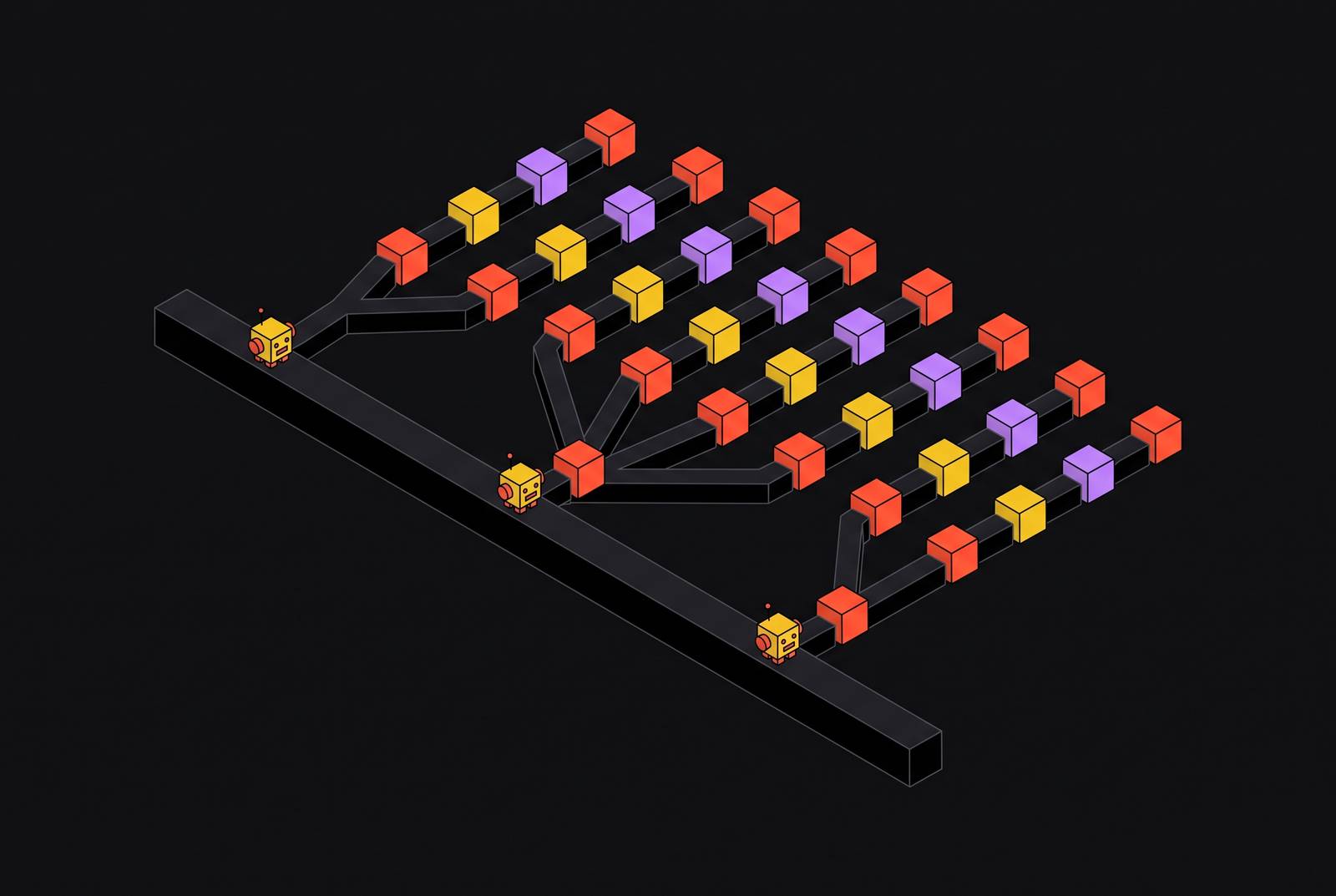
Parallel execution adds another source of accumulation. Concurrent sessions in isolated workspaces cannot share a branch checkout, so each session needs its own branch, and orchestrator fan-out multiplies that requirement. Retries can then produce families of related branches when an agent re-queues or re-branches after failure. Without an explicit relationship between those attempts, the pipeline has no clear canonical head to treat as the current candidate.
An agent that times out, is interrupted, or is replaced by a later session can leave its branch behind without a human noticing. Even well-behaved agents can produce this result because completing an execution session is not the same as resolving the lifecycle of its artifacts. The system must distinguish the end of an attempt from the end of the task.
What breaks when branch sprawl goes unmanaged at this scale
The first consequence is stale context. A branch that has diverged far from main presents an agent or reviewer with a diff that no longer reflects the current system. Wang & Liu describe the “invalidation pressure” produced by distributed concurrent execution. As active changes move forward, earlier assumptions become harder to trust, and abandoned attempts make it harder to tell which work still needs verification.
That ambiguity consumes delivery capacity. Branches whose agents continue retrying can draw on CI runners even when their attempts are no longer useful. The merge queue also encounters more speculative state invalidation when stale work is interleaved with active candidates. Because the cost of a bad merge event grows with queue depth, branch state affects more than the branch itself. It can increase the integration burden on work waiting behind it.
The same ambiguity weakens auditability. Without branch-level traceability, the system cannot reliably answer which agent produced a change or whether that attempt was accepted or abandoned. Forrester identifies governance and auditability as prerequisites for expanding agent autonomy. Branch sprawl adds noise to the stages that have limited capacity to turn generated code into an accepted change, including review, integration, and assurance. It is a reliability problem across the delivery pipeline.
Why developer-owned conventions cannot scale to agent-rate branch creation
A naming convention can identify a branch, but it cannot decide whether that branch should persist. CI rules or linting may enforce a name when a branch is created without tracking how task intent changes later. A correctly named branch can become an orphan as easily as an incorrectly named one. A PR-closure hook also handles a known endpoint but leaves an interrupted session unresolved if it never gets there.
The obvious stopgap is a cron job that deletes stale branches. That approach still needs maintenance, and a flat age threshold cannot distinguish an abandoned attempt from an intentionally long-running task. Its apparent completeness can create false confidence while valid work remains exposed to deletion. The missing input is intent.
Wang & Liu’s Human–Agent Cell framework separates execution authority from acceptance authority. An agent’s ability to open a branch does not give it authority to decide whether the resulting change should be accepted or the branch retained. Conversely, leaving that decision to a developer for every branch recreates the human bottleneck. Convention-based management cannot close this gap because it assigns responsibility without providing a machine-actionable account of task state.
The design principles of a policy-driven branch lifecycle for agent workflows
The replacement rests on four principles, namely explicit ownership at creation, state-machine lifecycle tracking, intent-aware expiry, and production-signal integration. Explicit ownership means that every agent-created branch carries machine-readable metadata identifying its agent session, orchestrator, and task ID. This gives lifecycle policy a responsible actor and a task to evaluate without guessing. Wang & Liu’s Trustworthy Change framework identifies untraceable provenance as a governance or assurance failure.
State-machine tracking makes the branch’s condition explicit through declared states, including active, stalled, superseded, pending-merge, and expired. Agent events should trigger transitions rather than leave the branch in an undifferentiated pool until someone investigates. Bhati’s Agentic SDLC Control Plane concept allocates autonomy subject to cost, reliability, and human-attention budgets. A stalled branch is consequently a signal to allocate attention.
A failed session and a valid multi-day task may both leave a branch unchanged, but they should not receive the same treatment. Expiry must account for task intent rather than infer abandonment from elapsed time alone. Otherwise, automation replaces inconsistent cleanup with consistent false positives.
Production-signal integration brings how much work the delivery system can handle into policy alongside the state of each branch. Queue state, CI health, and whether reviewers have time should help decide if the system can take on more work. Together, these principles make branch creation and retirement governed actions. The policy should remain a discrete, independently deployable component with a defined contract, so it can be extended or replaced without rebuilding the surrounding pipeline.
Implementing branch lifecycle policy in an agent-driven pipeline
Implementation begins where the necessary context exists. The orchestrator should register each branch when it starts an agent session because it knows the task ID, agent identity, and expected scope. Registration should write to a durable store that the merge queue can query. A PR comment is not a substitute for that machine-actionable record. The record supplies the context needed to distinguish legitimate long-horizon work from an orphan.
The merge queue is the natural enforcement point because it already has visibility into CI status, queue depth, and PR age. Lifecycle policy can use that visibility to detect stale branches and trigger expiry. An agent-operated queue that handles conflict resolution, CI failure triage, and routine queue management is better positioned to distinguish failure modes than a rule engine without that context. The purpose is not to make age-based deletion faster, but to apply intent-aware decisions where integration consequences are visible.
Agent events should update the registered state. Timeout, completion, or interruption should trigger a transition appropriate to the task’s condition, rather than allow an active label to persist after execution ends. An attempt may become stalled if it is interrupted, or superseded if later work replaces it. This wiring preserves the separation between producing a candidate and accepting it. The agent cannot silently keep a branch alive past its task’s end.
Before starting another session, the platform should check factory state, including merge queue depth, current CI health, and reviewer pickup time. If delivery is saturated, the session waits, keeping another branch out of the backlog. Supporting this rate of lifecycle activity also requires code storage with low-latency branch creation and deletion, API-first access, and sync semantics that do not assume a human-managed checkout. Otherwise, the storage layer itself becomes a latency bottleneck.
Where governance fits: human oversight without human bottlenecks
Wang & Liu’s Responsibility Topology framework classifies organizations by how they distribute acceptance authority, including the authority to accept residual risk. That authority is still needed when routine branch operations are automated. Humans should set expiry policy, define task-type categories, configure queue-saturation thresholds, and review exception reports. They should not need to approve every session or manually delete every abandoned branch.
The strongest objection is that complete lifecycle rules require stable specifications that agent behavior may not provide. New retry patterns and branch families can outrun the policy author’s assumptions. Policy needs to be versioned and observable. Bhati’s Production-Qualified Change concept makes reliability gates a condition of counting a change as complete. Lifecycle policy should face the same test against how agents behave before it is enforced more widely.
Agent transcript analysis supplies the feedback needed to revise those rules. Platform engineers can look at which task types create orphans and which retry patterns lead to branch families. That evidence can guide changes to expiry windows and session gates without treating every exception as a separate manual cleanup task. Forrester identifies governance that scales with adoption as essential. As agents gain autonomy and take more automated actions, teams also need to get better at explaining and changing policy decisions.
How to sequence the transition from ad hoc cleanup to lifecycle infrastructure
Begin the transition with observation by instrumenting the existing pipeline to measure branch age distribution, orphan rate by agent type, and CI consumption by branch state. These measurements establish a baseline against which proposed policy can be evaluated. Bhati identifies AI observability as a core part of the Agentic SDLC Control Plane. The infrastructure that tracks token cost and CI minutes should also track branch lifecycle metrics.
Next, require orchestrators to register branch metadata at session start without applying expiry rules. This gathers the evidence for intent-aware decisions without the risk of deleting work too soon. Then have session termination events trigger updates to branch state. This is the lowest-risk automation step because it changes only a label, preserving the work. Humans and the queue can act on the resulting distinction between active, stalled, and superseded attempts.
Once state tracking is useful, introduce queue-layer enforcement. Stalled or superseded branches can receive lower priority, a shorter retry window, or automatic archival after a defined interval. Validate those decisions against the baseline before expanding their scope. Add pre-session factory-state gates last, after queue enforcement has shown that policy is stable and not producing false positives. These gates have high leverage, but they also decide whether new work may begin.
Each stage should be independently deployable and reversible. Anthropic’s 2026 report identifies organizational readiness as a constraint on agent adoption, which makes a sequenced rollout more credible than a single configuration event. Start by making branch intent visible, then make state reliable, and only then let policy govern retirement and admission.
Sources
- Beyond Code Generation: Reliability, Verification, and Cost Economics in the Agentic Software Development Lifecycle
- Software Engineering in the Agent Era From Trustworthy Change to Human Agent Software Organizations
- Agentic Software Development Takes The Lead: From Code Assistants To Orchestrated SDLC Agents
- How GitHub uses merge queue to ship hundreds of changes every day - The GitHub Blog