Composable Infrastructure vs Monolithic DevOps Platforms for Software Factories
Monolithic DevOps platforms can't handle machine-speed software factories.
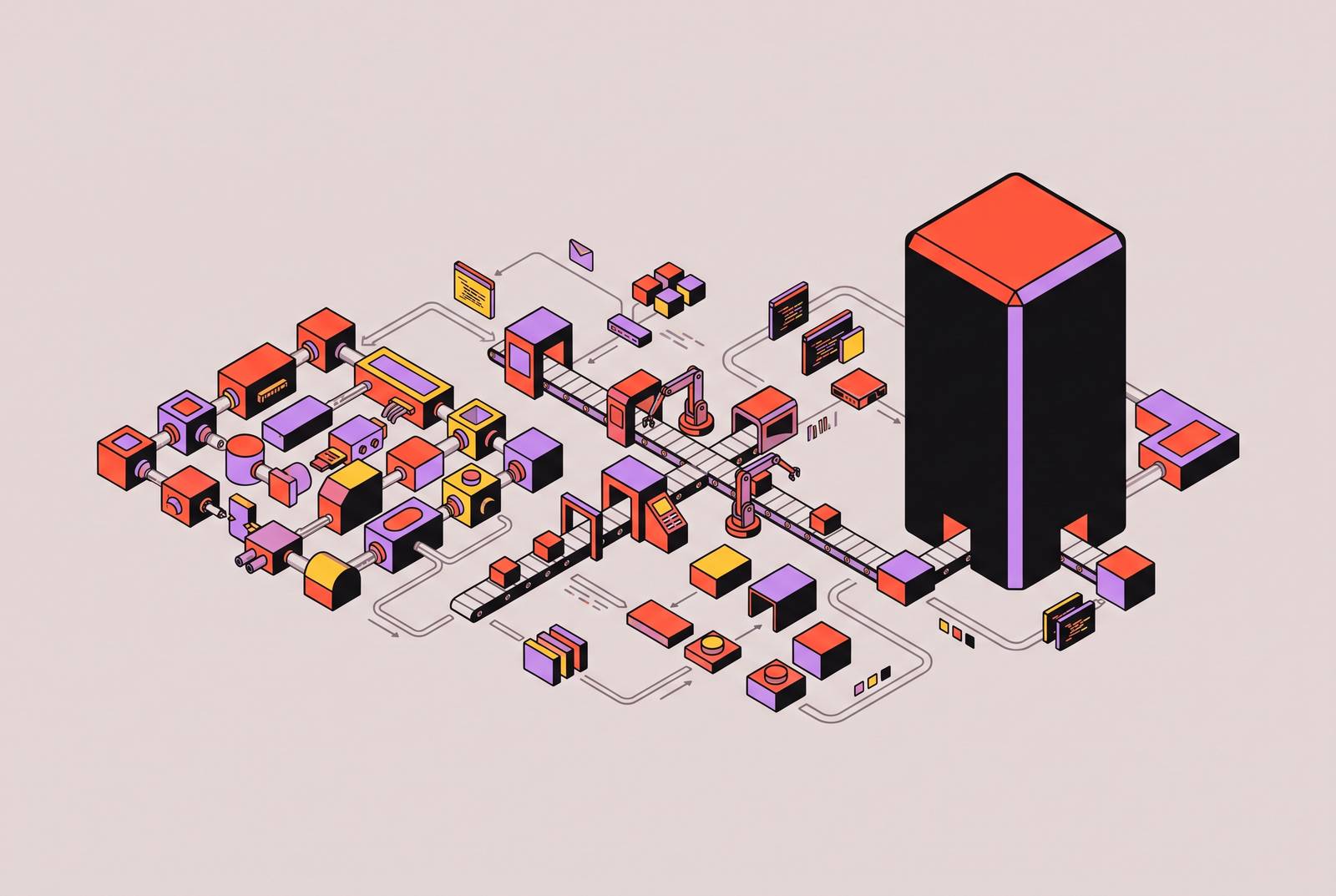
Buying one platform that handles the entire development lifecycle has an obvious appeal: one vendor, one contract, one support line to call when something breaks. That appeal is why monolithic DevOps suites became the default purchase for so many engineering organizations over the last decade. That convenience rests on a human-throughput assumption that no longer holds, and that assumption is what breaks under machine speed. Monolithic DevOps platforms were built around human throughput: one developer, one pull request, one review cycle, moving at the pace a person can sustain. Software factories run at machine speed now, so the platforms built for human pacing are turning into a structural liability instead of a convenience.
The Lidl case shows what happens when a platform's built-in assumptions no longer match how the business works. Between 2011 and 2018, Lidl attempted to implement a monolithic ERP system, and the attempt ended in a loss of nearly $500 million because the system could not accommodate how Lidl actually priced its inventory. The failure wasn't a matter of bad technology. It came from a mismatch between what the platform assumed about the business and how the business actually operated. You can see the same mismatch now in engineering organizations, where monolithic DevOps suites can't handle agent-generated pull requests, automated merge cycles, or CI feedback loops that run at machine speed. The platform wasn't built for the volume and velocity a software factory produces, and you can't configure your way out of that.
What a software factory is and why it runs differently from a human development team
A software factory is a different kind of system altogether: automated, agent-driven pipelines in which AI agents write code, open pull requests, run tests, fix failures, and respond to review comments, while humans provide approval and architectural direction rather than line-by-line execution.
The dominant pattern in 2026 is multi-agent, not single-agent. An orchestrator breaks a task down, specialist agents take on distinct responsibilities such as security review, performance tuning, or test coverage, and the results get synthesized back together. So a factory generates work across several parallel tracks at once, not one task after another. The volume of concurrent activity a factory produces has no real analogue in a human team, where one person works on one branch at a time.
The distinction between synchronous and asynchronous agents adds another layer of operational complexity. A synchronous agent keeps the developer in the loop while it edits code, but an asynchronous agent runs in a cloud or isolated environment after a developer delegates a task and moves on. These modes put different demands on merge queues, CI pipelines, and storage, and a single monolithic platform has no way to tune itself independently for each one. A merge queue built to serve one mode well will serve the other poorly, and a monolith can't run two configurations of itself at once.
Warp Factories describes the control plane of a software factory as a system that "starts, sequences, and governs agent work," where a foreman agent takes intake from Slack, Linear, Jira, and GitHub, then splits that work across triage, spec, implementation, and review subagents. That kind of orchestration was never part of what a monolithic DevOps suite was designed to handle. The factory doesn't just produce more pull requests than a human team. It produces work shaped differently altogether, spread across specialist agents running on their own timelines, and a platform built around one developer's single PR has no native way to represent that.
The three specific failure modes that emerge when a software factory runs on a monolithic platform
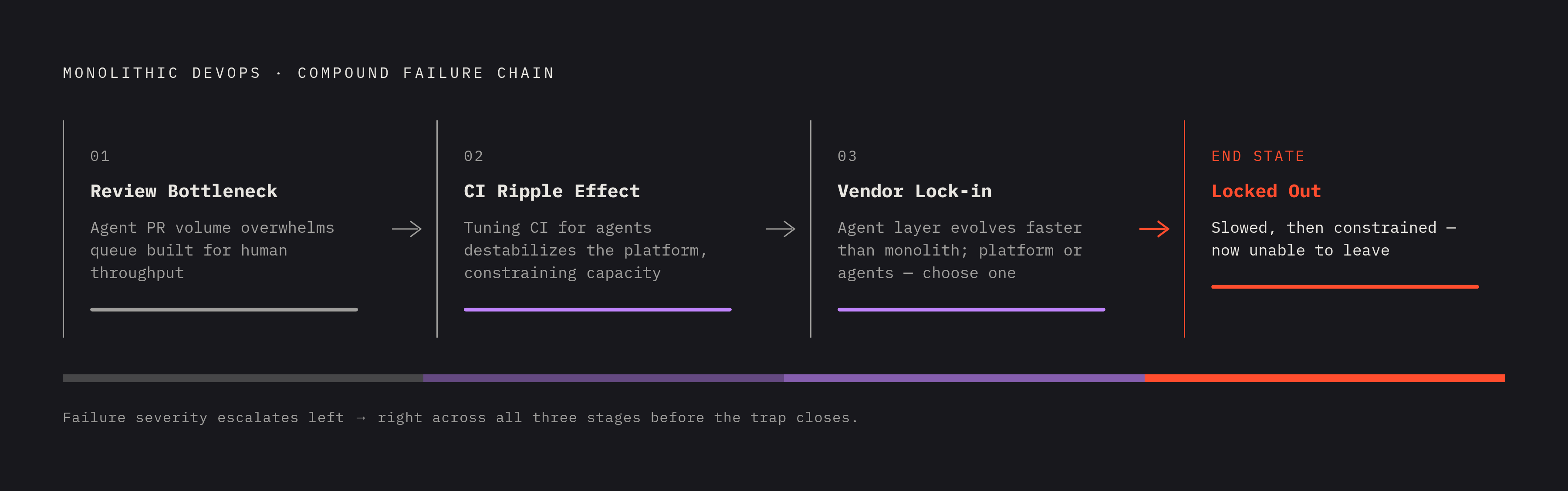
Monolithic platforms break down against software factories in three distinct, compounding ways: they create review bottlenecks once PR volume reaches machine-generated scale, they can't let teams tune individual CI/CD components without triggering ripple effects elsewhere, and they leave teams with no real recourse when a vendor sunsets or changes a feature the agentic workflow depends on.
The first is the review bottleneck. Monolithic DevOps suites were designed for human throughput, and their queue management has no native answer for a world where an asynchronous agent fleet opens dozens of pull requests at once instead of a single developer opening one at a time. Adding more human reviewers doesn't fix this. So you need a merge queue built to understand agent-generated PR volume, one that can validate, batch, and sequence it at machine speed.
The second is the ripple effect on CI tuning. In a monolithic system, customizing one workflow can force changes that spread unpredictably into others, and in a software factory, tuning CI for agent-generated PRs (different test strategies, speculative batching, parallel stack runs) risks destabilizing the whole platform. So teams stay inside the vendor's default CI behavior even when it doesn't match their factory's actual pipeline, because touching it risks breaking something unrelated. The first failure mode slows the factory down. This one constrains what the factory is even allowed to become.
The third is vendor roadmap lock-in on infrastructure the factory has come to depend on. When a vendor sunsets a feature or shifts its product strategy, you have little recourse beyond accepting the change or undertaking a full migration. For a software factory, this risk is sharper than it is for ordinary enterprise software, because the agentic workflow layer is the part of the stack evolving fastest. If a monolith can't move at the pace of the agent tooling ecosystem, it eventually forces a choice between keeping the platform and keeping the agents that depend on tools the platform wasn't built to support, the trap at the end of the three failure modes: a factory that's been slowed, then constrained, finds itself finally unable to leave.
Why Composable Infrastructure Resolves Each Failure Mode
Composable infrastructure answers each of the three failure modes because its defining trait, modular components that operate independently and connect through open interfaces, is what each failure mode calls for: a merge queue tunable without touching CI, a CI layer swappable without migrating the whole platform, and storage able to evolve alongside agent tooling without needing a vendor's permission.
Against the review bottleneck, a purpose-built merge queue component can handle agent-generated PR volume, validating, batching, and sequencing at machine speed, without being bound to the rest of the platform. GitHub's Merge Queue ships natively inside branch-protection rules, creates temporary refs, and supports grouping through configurable minimum and maximum group sizes, but those limits govern final merges, not the combining of separate speculative CI builds. Graphite's merge queue takes a stack-aware approach, understanding the relationships between stacked pull requests and running CI for an entire stack in parallel before a fast-forward merge. After Shopify adopted Graphite, it reported more pull requests merged per developer, with most of its PRs flowing through the tool, and Asana shipped more code as a result. So a composable queue component actually resolved the bottleneck instead of just moving it somewhere else in the system.
Against the CI ripple effect, composable architecture lets you connect different content repositories, modify individual components, or add new capabilities without disrupting or rebuilding the whole system. In a software factory, that means CI can be tuned for agent workloads on its own terms, independent of queue management, storage, or observability. GitOps supplies the connective tissue here: with Git as the single source of truth for deployments, changes to one component stay declarative and auditable without cascading risk into the others. This composability directly counters the CI ripple effect, where a single configuration change in a monolithic platform can cascade unpredictably across queue management, storage, and observability.
Against vendor lock-in, open standards such as Apache Iceberg, Parquet, and open S3-compatible APIs decouple data and tooling from any single vendor, so that in a composable factory, each layer can be replaced as the agent ecosystem evolves without a full migration. The strongest case for composable architecture is the optionality it preserves: when a better tool appears, a team adopts it, and when the workflow changes, the team reconfigures rather than migrating the whole platform.
The honest objection to all of this is that composable architectures require someone to own the connections between tools, manage data quality, and maintain integration logic, and without that organizational capability in place, composability delivers chaos dressed up with good API documentation. That's a real cost for general enterprise composability. But platform engineering teams already running software factories have the DevOps muscle to own those integrations, because the factory's existing CI/CD and agent orchestration work already demands exactly that capability. The real choice is whether to spend that integration competence on purpose-built components or on working around a monolith's constraints.
What a composable software factory stack looks like in 2026
A composable software factory stack in 2026 is built from distinct layers that each operate on their own: developer portal, infrastructure provisioning, delivery, runtime, observability, security, and agent infrastructure, with each layer upgradable or replaceable without destabilizing the rest of the stack. The developer portal layer is typically served by tools like Backstage, Port, or Cortex. Infrastructure provisioning runs through Crossplane, Terraform paired with Atlantis, or Pulumi. Delivery is handled by ArgoCD, Flux, or Spinnaker. Observability draws on the Grafana stack, Datadog, or Honeycomb, and this is a layer where composable architecture makes an especially clear difference: in a composable stack it can be swapped out independently, while in a monolith it can't. Security runs through tools such as OPA, Kyverno, Vault, and Trivy. Agent infrastructure, the newest and least settled layer, covers custom integrations, merge queue tooling, agent transcript analysis, and cloud-native code storage.
GitOps functions as connective tissue across all of these layers rather than as an optional add-on. It makes Git the single source of truth for deployments, provides declarative and auditable state management across the whole stack, and by 2026 is treated as foundational to managing cloud-native systems generally. Crossplane fits this same logic: developers create Kubernetes objects and Crossplane provisions the underlying infrastructure directly, cutting out the ticket-filing and console navigation that used to sit between a request and its fulfillment.
Platform engineering teams in 2026 are prioritizing the standardization of infrastructure provisioning and consumption through an internal developer platform, and they hold improving developer experience as a strong secondary goal. A composable stack serves both priorities at the same time, because each layer can be optimized for the people who actually use it, security engineers tuning policy, developers tuning their portal, without requiring a stack-wide upgrade to do it. That's what distinguishes the composable stack from the monolith in practice: not a single feature, but the fact that every layer above can change shape without forcing every layer around it to change shape too.
The agent infrastructure layer is the part of the stack monolithic platforms are least equipped to handle
Among all the layers in a composable factory stack, agent infrastructure, the merge queue, transcript analysis, and cloud-native code storage, is the layer monolithic platforms are least able to serve, because it demands performance characteristics and operational logic that simply weren't part of their original design.
The clearest example is the merge queue built specifically for agent-generated pull requests. An agentic merge queue has to handle merge conflicts, CI failures, and queue management at machine speed, so it can reserve human attention for decisions that genuinely need judgment instead of routing every routine queue task back to a developer the way a monolith's default branch protection does. Vex's Agentic Merge Queue is built around that exact problem: AI agents handle the operational work of merge queue management, so humans step in only where a decision actually calls for their judgment. So it works as a composable component that fits into a factory's existing delivery layer, and you don't need a wholesale platform replacement.
Understanding how specialist agents operate across their parallel tracks, security review, performance tuning, test coverage, and how synchronous and asynchronous agents place different demands on infrastructure, requires real visibility into how those agents are actually using their tools and skills day to day. Agent transcript analysis is what makes those patterns visible, and it gives teams a way to cut dead weight out of their agent harnesses and tune them with evidence rather than guesswork, which is turning into one of the sharper levers available for factory optimization.
GitHub's Merge Queue remains a credible option if your team already works inside GitHub's branch-protection model, since it gives you native grouping and queue sequencing without a separate tool. Graphite's stack-aware queue is a strong fit if your workflows already lean on stacked pull requests, running CI for a whole stack in parallel before a fast-forward merge rather than relying on general-purpose queue management. The right choice depends on how a given factory's PR volume is actually shaped, how much of it is stacked work, how much is agent-generated, and how much still runs through a single human's branch. What all three approaches share is the same underlying premise: the merge queue is infrastructure, and a factory running at machine speed needs that infrastructure built for the volume it actually produces rather than the volume a human team once did.
Sources
- Disposable Software Is the Future: Why Composable Architecture Beats Monoliths and Overbuilt Microservices | Chris Pietschmann
- The Rise of Composable Architectures to Replace Traditional Platforms - DevOps.com
- Platform Engineering in 2026: 5 Shifts Driving the Rise of Internal Developer Platforms - Growin