Production Signal Integration Into Agentic Development Pipelines
Agents need real-time production feedback to correct themselves, not dashboards.
Picture an exception thrown in production at 2 a.m. It lands in a dashboard, waits for a human to open it the next morning, and sits there while the agent that wrote the code keeps generating new PRs against the same broken assumption. That lag is the subject of this piece: agentic development pipelines do not become self-correcting on their own. They become self-correcting only when production signals get routed as live inputs that agents act on directly instead of as metrics that collect in a dashboard for a human to check later.
The standard setup today has agents writing code, opening pull requests, and operating inside CI/CD, but the feedback mechanism still assumes a person reads an exception report or a deploy-failure email and decides what happens next. That worked when humans wrote the code and humans reviewed the fallout at roughly the same pace. It breaks once agents generate PRs faster than any team can review dashboards, because the dashboard model was built for a world where humans read the dashboard, and the thing generating the next action here can't read it.
Teams often measure agent workflows with eval scores and demo-pass rates, and those look good in the prototype phase, but once real users show up, they stop tracking production reality. Nobody on the team can answer basic operational questions the business is going to ask: is this still working, and how do you know?
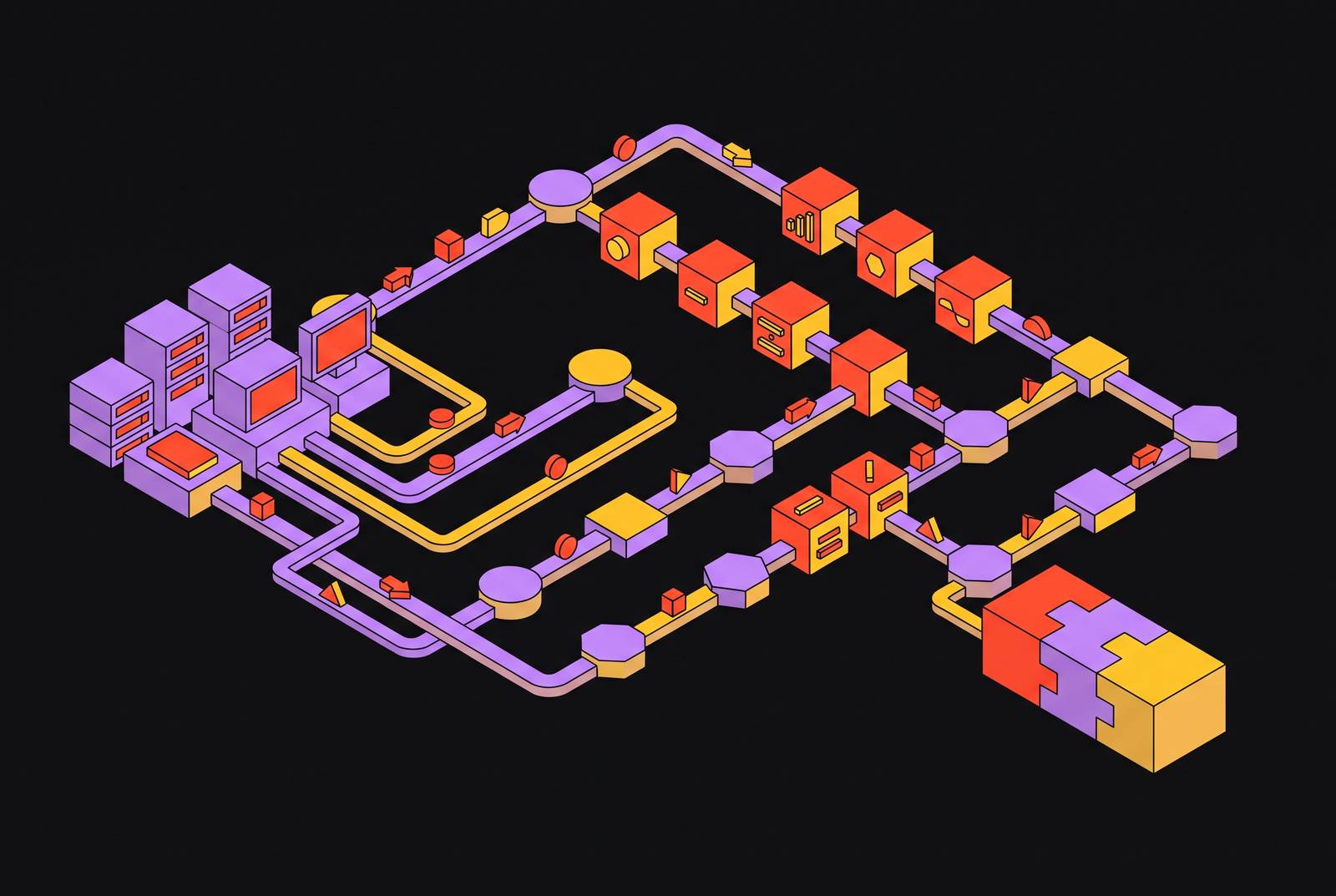
A signal routed to a dashboard is a report. A signal routed into the pipeline is an instruction. The gap between those two things, a report that waits for a reader versus an instruction that triggers an action, is the architectural gap this piece examines.
Agent adoption has outrun the feedback infrastructure beneath it
Agents have moved into code authoring far faster than the infrastructure meant to close the loop on their output has moved with them. An empirical analysis of more than 129,000 public GitHub projects, spanning every maturity level, established organizations, and a wide range of languages and domains, found that between 16% and 23% had already integrated agentic coding tools within months of their general availability, a present condition, not a future trend.
The gap concentrates exactly where signal routing matters most: the delivery layer. Teams have grown comfortable delegating text generation, the writing of code, to agents, while keeping the decisions inside the pipeline itself, what merges, what deploys, what gets retried, firmly in human hands.
The result is a structural mismatch rather than a judgment on anyone's caution. Neither side of that pipe has changed its throughput assumption to match the other, and the strain appears first in delivery, which was built slowest to adapt.
Closing the Agentic Loop on Production Feedback
A production-ready agentic loop needs structured observability built into every phase of its own operation, not bolted on afterward as an audit trail. The observability has to work as the channel through which the agent finds out whether its last action actually worked.
Anthropic documents the recommended shape of this loop as four phases: Explore, Plan, Implement, Commit. Each phase produces output the next phase needs as input, and the loop only closes if verification results make it back into the agent's context before the next cycle starts. Skipping that re-entry step leaves the phases running in sequence rather than forming a loop. They become four disconnected stages instead of one feedback system.
Minimum signals to collect for any production agentic system include token consumption per task, how often tools get invoked and how often those invocations succeed, task completion rates, how often a human has to step in, and the distribution of error classes the system is throwing. These tell an agent whether it's operating normally or sliding toward degradation, and without them it has no baseline to compare the next action against.
Some teams go further and embed evaluation probes directly inside active agentic workflows, running adversarial checks that assess factual grounding, produce a structured verdict, and log the reasoning behind that verdict to a machine-readable audit trail. That gives a real-time read on quality and a record a compliance team could actually defend later.
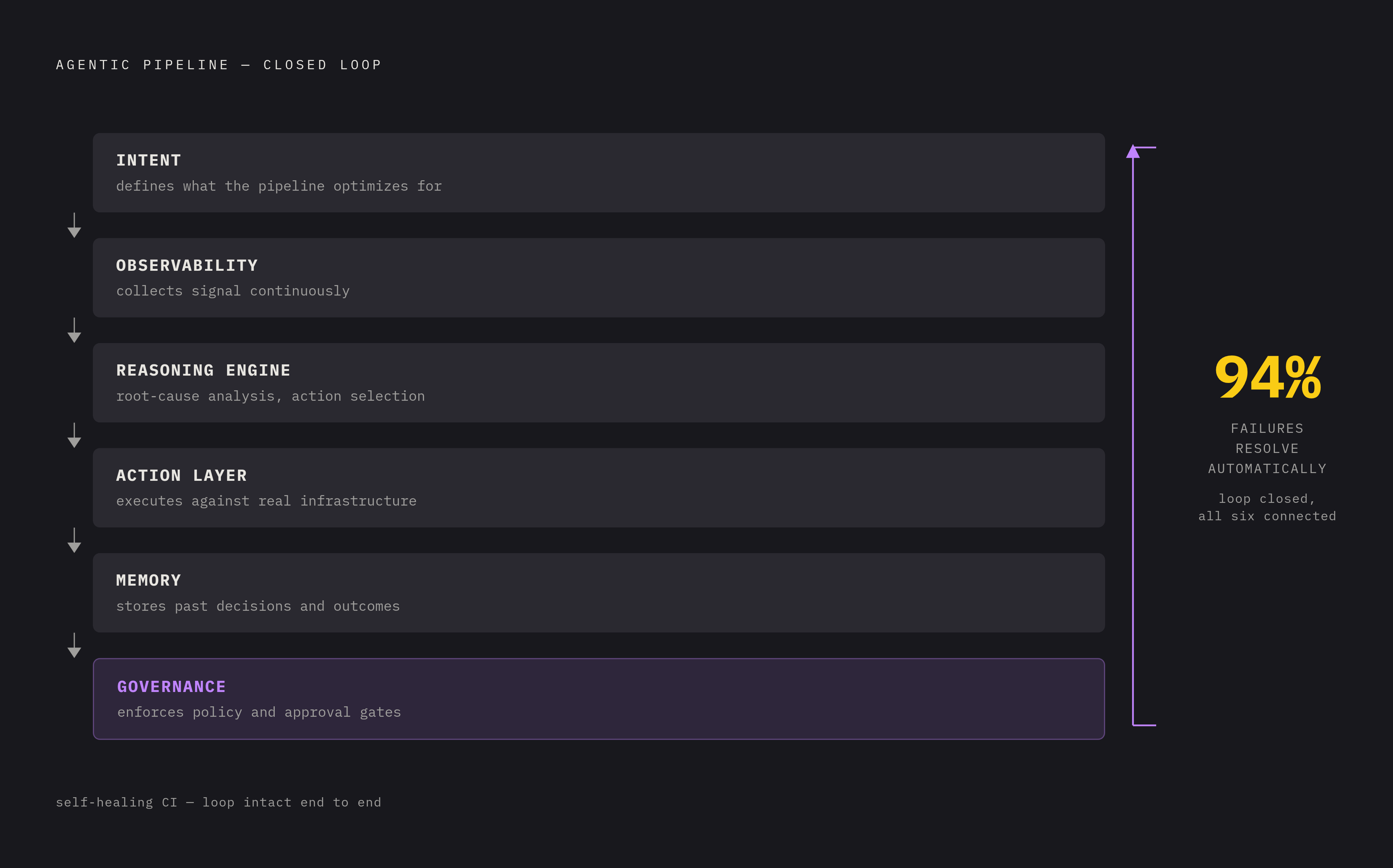
Without observability, the agent operates blind in the stretch between commits. When systems implement self-healing CI patterns, where the loop stays intact end to end, 94% of failures resolve automatically, evidence that the loop, not the model underneath it, is what does the self-correcting.
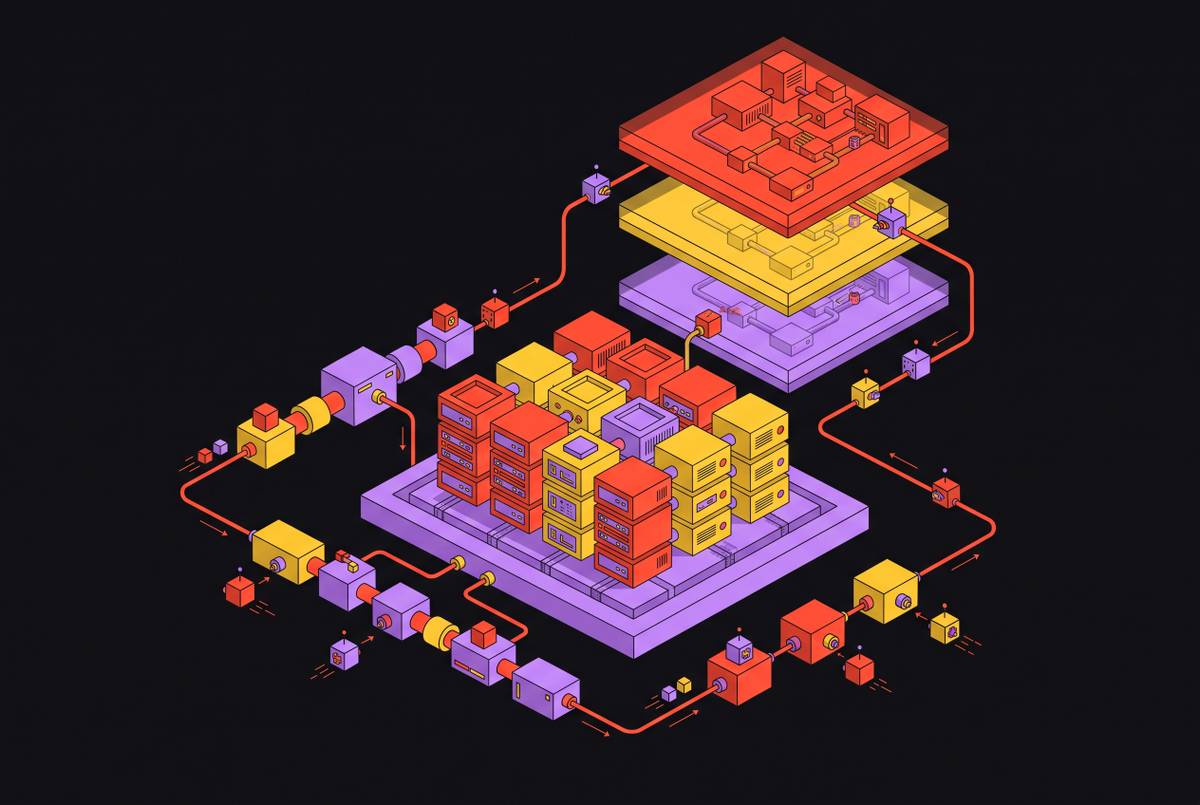
An instrumented agentic pipeline runs on six layers working together: intent, which defines what the pipeline is optimizing for; observability, which collects signal continuously; a reasoning engine, which does root-cause analysis and picks an action; an action layer, which executes against real infrastructure; memory, which stores past decisions and their outcomes; and governance, which enforces policy and approval gates. The six layers function as one mechanism, and the loop only closes when all six stay connected.
Why exceptions, deploy failures, and query degradation matter most
Not every production signal carries the same weight for an agent that ships code. Three classes matter more than the rest because they're the most reliable indicators that an agent's last action introduced a regression: exceptions, deploy failures, and query degradation. They're also, not coincidentally, the three signal types most often left sitting in a dashboard instead of routed back into the pipeline where the agent could act on them.
An exception tells you that code an agent wrote is failing at runtime in a way its own test suite never caught. If it's left in a dashboard, that exception becomes a report a human reads hours later. Routed into the pipeline, it becomes evidence that the agent's verification step has a hole in it, the exact information the agent needs to adjust the next PR instead of repeating the same gap.
A deploy failure is a binary signal that fires at a known boundary: the code did not survive promotion. If that signal never gets routed back, the agent has no basis at all for changing what it does on the next attempt. It just tries again with the same blind spot intact.
Query degradation behaves differently, and that difference is what makes it the most dangerous of the three. It doesn't throw an error. By the time someone notices the query times climbing or the result quality sliding, the agent has shipped several more PRs on top of the problem.
The observability layer tracks failures, schema drift, anomalies, and SLA breaches in real time, and those tracked signals form the foundation the whole decision-making process rests on. Without them the system has nothing to compare its current state against and no way to respond.
This logic already runs operationally in canary deployments. That's production signal integration working exactly as the architecture intends: the signal reaches the system in time to act, not in time to be read.
How high agent PR volume turns a slow merge queue into a system-wide failure
Once agents generate pull requests at real volume, the merge queue no longer just acts as a simple sequencing convenience. It becomes the one point in the system where a missing production feedback loop turns into a failure that compounds across the whole team.
Agents worsen the flaky-test problem in a specific way. An agent told to "get the PR merged" will re-queue the same change over and over, burning a full CI run on each attempt and re-triggering the same cascade of delay for everyone else waiting behind it in the queue. Retry behavior that was mildly wasteful at human frequency turns into something close to a denial-of-service attack once agents do it. Uber's engineering teams ran into exactly this dynamic: agents retrying against flaky tests at volume turned what used to be an occasional nuisance into a system-wide slowdown that degraded CI for every engineer sharing the fleet, human and agent alike.
The root cause is what information the agent has access to. It has no production signal telling it that the test itself is flaky rather than its code being wrong, so it treats every CI failure as a code problem and retries accordingly, forever, because from where it sits that's the only explanation available.
The structural fix under discussion replaces post-merge CI with a pre-merge queue: a script that runs the full test suite before anything merges to main, with agents given their own version of that same command so they can catch and fix failures before inflicting them on everyone behind them in line. In this model, a test suite that runs slowly or gets deferred is no longer just a minor inconvenience. It becomes a daily liability, because every deferred test is another opportunity for an agent to retry blind.
The architecture that routes production signals back into the pipeline before the merge
Self-correcting agentic pipelines converge on one architectural pattern regardless of vendor: production signals get intercepted at the pipeline boundary and converted into structured input the agent receives before it decides whether to merge, retry, or escalate. OpenAI's engineers run roughly 660 builds per day each, a volume at which any gap in the feedback loop multiplies into real operational cost almost immediately.
The pattern needs three connected pieces working together: a signal ingestion layer that collects exceptions, deploy results, and test outcomes in structured form; a reasoning step where the agent reads those signals against the actual intent of its task; and a governance layer that decides which calls the agent can make on its own and which calls need a human. When runtime governance is enforced deterministically at the infrastructure layer rather than as a suggestion to the model, it stops bad actions before they ever reach production. The Microsoft Agent Governance Toolkit takes a hard line on this point: a blocked action is structurally impossible rather than merely statistically unlikely.
A handful of named platforms show this pattern at different scales. IBM's "Bob" platform, launched April 28, 2026, runs multi-model orchestration with persona-based agents that handle planning, coding, testing, deployment, and operations across the full lifecycle, from early discovery through live production monitoring. IBM's platform is the enterprise-scale version of the same signal-routing idea. GitHub Agentic Workflows, which reached technical preview in February 2026, introduces what GitHub calls "Continuous AI" as a complement to Continuous Integration: engineers write workflow logic in plain Markdown, and the AI handles the decision-making inside that same workflow definition rather than in a separate monitoring tool bolted on afterward. LinkedIn takes a different route to a similar destination: it extends its existing microservice infrastructure so each agent runs as its own GRPC service registered in a skill registry, coordinated by a central orchestrator, and that's where production signals get injected as context before the agent picks its next move.
None of these four implementations look alike on the surface. What they share is the same underlying shape: signal comes in, structured reasoning acts on it, a governed action follows. This convergence across independently built systems suggests the pattern can be reproduced and isn't particular to any one company's stack.
Where human judgment still belongs in a signal-driven pipeline
You can route production signals straight into the pipeline without taking humans out of it. It means reserving human judgment for the decisions that actually need a person and automating the rest.
The objection deserves a direct answer rather than a dismissal: if agents act autonomously on deploy failures and exceptions, who answers for it when an agent acts wrongly? Platform teams have already watched autonomous systems make bad calls in production, and that is why the tiered-autonomy model exists. The governance tier the decision falls into determines accountability, regardless of whether automation touched the decision.
Regulation has started to formalize that boundary. The EU AI Act's Article 14 requires human oversight mechanisms for high-risk AI systems, including verified confirmation steps for certain classes of decisions. Governance tiers have stopped being just an engineering preference and have become, for a growing share of these systems, a compliance requirement with legal weight behind it.
The DORA 2025 report gives you the empirical case for why the tiers matter even without the regulation. It found that AI adoption correlates with higher throughput but also with reduced stability, so if a team lacks the governance to keep that speed stable, the speed gains agents produce turn into a net loss. Tracking how often an agent escalates to a human tells a team whether its tiers are calibrated correctly, or whether agents are either escalating too often and wasting human attention, or not escalating enough and making calls they were never supposed to make alone.
Why composable, purpose-built infrastructure handles signal routing better
Signal routing at this level of precision, distinguishing a flaky test from a real regression, catching query degradation before it compounds for a week, deciding which action needs a human and which doesn't, asks more of the infrastructure than a single all-in-one platform tends to deliver. Red Hat's Cicaddy works because it plugs into CI stages already defined in standard pipeline configuration, so you don't have to migrate those stages into a new proprietary format. GitHub's Continuous AI works because it sits inside the workflow definition a team already writes, so you don't need a separate system to watch that workflow from outside.
A monolithic platform that tries to own ingestion, reasoning, action, memory, and governance all at once has to make every one of those layers generic enough to fit every customer's pipeline. Composable, purpose-built tooling can instead make each layer specific: a signal ingestion tuned to the exact shape of exceptions and deploy failures a given stack produces, a governance tier calibrated to the actual risk profile of the decisions an agent faces there. The pattern that recurs across IBM, Red Hat, GitHub, and LinkedIn is a shared architecture, assembled from pieces purpose-built for the signal types and decision boundaries each team actually has to manage, and that architecture is what lets production feedback close the loop instead of waiting in a dashboard for someone to read it.
Sources
- Building Production-Ready AI Agents in 2026 | MLflow
- How to develop agentic workflows in a CI pipeline with cicaddy | Red Hat Developer
- Agentic CI/CD: AI-Driven Delivery Pipelines and the Rise of CA/CD
- The Merge Queue Is the New Bottleneck - TianPan.co
- Agentic Data Pipelines: AI-Driven Autonomous Data Engineering in 2026
- Humans are Missing from AI Coding Agent Research