Platform Engineering for Agentic Software Development Workflows
Infrastructure built for human developers now bottlenecks when agents drive delivery at scale.
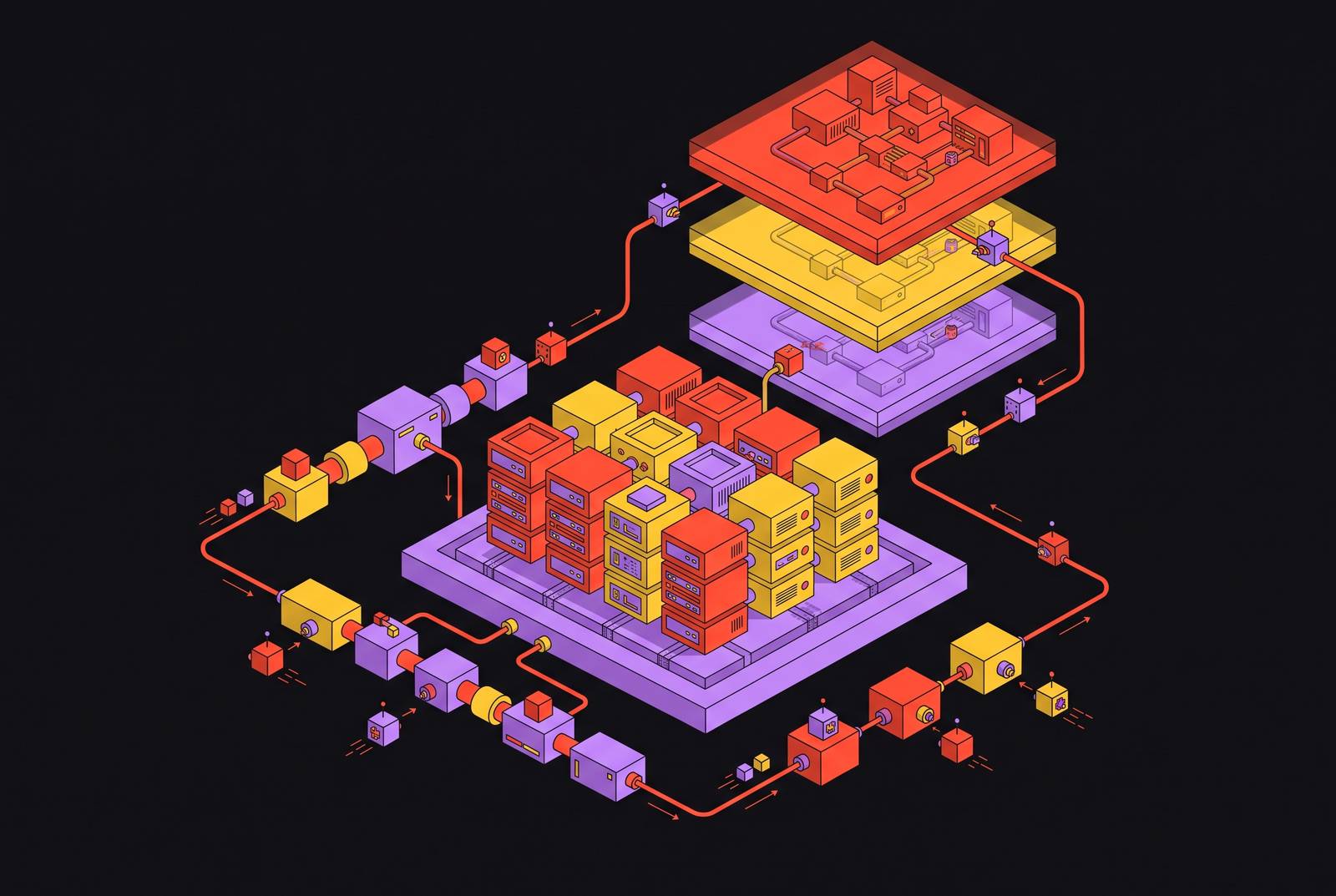
Agentic AI no longer just assists with coding; it now takes part directly in the software delivery lifecycle, and most organizations run an internal developer platform that was never built for that role. The shift requires a ground-up rethink of what platform infrastructure has to provide.
Agent-driven teams need the internal developer platform as essential infrastructure
The distinguishing feature of this generation of AI tooling is that the models now sustain execution across long, multi-step workflows: reasoning through a task, invoking tools, interpreting the results those tools return, and iterating without a human re-prompting at every step. That capability changes what an agent can be handed. Where a coding assistant once suggested a function inside an IDE, an agent can now generate code, troubleshoot errors it encounters along the way, open pull requests, manage infrastructure tasks, and participate across the full arc of a delivery workflow rather than one isolated stage of it.
This is a mechanics problem before it is anything else. An agent does none of that by default. It performs its assigned steps independently, calls the tools it has been given, and responds only to whatever the platform exposes to it. If the platform does not expose a permission boundary, the agent does not intuit one. If the platform does not surface the right environment, the agent proceeds with whatever it has access to, correct or not.
Repository access illustrates the gap clearly. Letting an agent read and write to a codebase is not the same as equipping it to safely ship production software, and without reliable environments, standardized workflows, observability, permissions, and deployment controls, agent-driven development generates as many operational problems as it resolves. Platform teams built their internal developer platforms to serve human judgment and human pacing. Agents have neither, and the infrastructure that was adequate for one no longer holds for the other.
CIO.com, writing in February 2026, framed the question facing platform teams this year as settled on one front and open on another: AI is already participating across engineering workflows, and what remains undecided is how deliberately an organization designs the infrastructure that governs that participation. Anthropic's 2026 Agentic Coding Trends Report adds the competitive dimension: the distance between organizations that adopted agentic workflows early and those still catching up is widening, and the teams that work out how to scale human oversight without creating new bottlenecks are the ones positioned to hold quality steady while moving faster. Neither source frames this as optional infrastructure work. Both frame it as the defining platform question of the year.
What an agent-native IDP requires beyond a human-centric one
An agent-native internal developer platform is not a conventional IDP with a chatbot wired into the dashboard. It requires machine-readable interfaces, explicit permission boundaries, structured feedback, and full traceability, none of which most existing platforms were built to supply.
Start with the interface itself. An agent needs something it can parse programmatically: a way to discover what capabilities the platform exposes and invoke only the actions it has been approved to take.
Permissions follow the same logic, and they matter more here than they do for human access control. If an agent has no clearly defined boundaries, it cannot limit itself. Tight, explicit permission boundaries are not a defensive afterthought for agent infrastructure; they are the only thing standing between a scoped task and an unscoped one.
Environments carry a parallel risk. When a human developer lands in an ambiguous or misconfigured environment, they usually notice something is off and stop to investigate. An agent does not self-correct for that ambiguity the way a person would. Development and testing environments have to be reliable and isolated by design, not by the agent's judgment after the fact.
Feedback has to change shape too. Agents need structured operational feedback formatted for machine consumption, so the same observability data that once served an on-call engineer now has to double as an input an agent can act on directly.
Validation and governance follow from there. Guardrails belong in the platform itself, enforced automatically, not left to whatever instructions happen to be sitting in an agent's prompt. And because agents are operating autonomously inside production workflows, every change they make needs a traceable record. Auditability is the condition that makes autonomous operation defensible.
The DEV Community, writing in September 2026, captured the underlying design shift: an effective AI-ready IDP turns infrastructure and engineering workflows into capabilities that are discoverable, structured, and controllable, rather than capabilities that merely exist and wait to be interpreted by a human operator.
Port, also writing in September 2026, distilled this into five platform capabilities that support agents directly. Agent governance applies access controls, organizational standards, and approval flows consistently, so that agents earn the ability to take on progressively more consequential work rather than being granted it all at once. Auditability logs every agent action so that root cause is findable when something breaks, and that same log feeds the loops that improve the system over time. Extensibility lets engineers build domain-specific agents and workflows on top of the platform, because if only platform engineers can extend it, it turns into a bottleneck as soon as demand for agent workflows grows.
The underlying principle behind all five is familiar to anyone who has worked in platform engineering: treat platform capabilities as products. That principle now has to serve a broader set of users than it once did. The audience includes application developers, SREs, security teams, data engineers, AI coding agents, and autonomous troubleshooting workflows, all drawing on the same capabilities. So platform teams now focus on building infrastructure that lets agents work effectively, securely, and reliably across the entire software delivery lifecycle.
None of this stays theoretical for long. The first place these design gaps turn into an operational emergency is the merge queue, where agent output volume meets infrastructure that was never sized for it.
The merge queue as the first critical failure point when agents drive PR volume
The merge queue is where agent-driven delivery first collides with the limits of existing infrastructure, and the cause is not a decline in code quality. Agent-driven PR volume exceeds queue throughput by design, because the queue mechanics in most pipelines were sized for the pace of human typing, not the pace of parallel agent execution.
But the arithmetic changes once a single developer can direct several agents across parallel worktrees at once. PR volume stops tracking headcount; it now tracks agent count and task parallelism. Qovery's 2026 research found that teams with high AI adoption merge nearly twice as many pull requests as they did before adopting these workflows, yet their delivery metrics barely move, because every one of those additional PRs still has to pass through the same review pipeline, the same CI fleet, and the same merge queue that was built for human-scale throughput.
The queuing math is unforgiving. If merge-group CI takes a substantial amount of time end to end, a strictly ordered queue can only land a small number of pull requests per hour, no matter how many pile up behind them. The queue does not get faster because the work arrived faster. It simply backs up.
Flaky tests turn this backup into something worse. At agent frequency, that same flaky test turns into something closer to a denial-of-service attack on the merge queue, because the volume of attempts passing through it multiplies the cost of every failure. Retry behavior that was mildly wasteful when a human was doing the retrying becomes a structural failure mode when an agent does it at machine speed and without fatigue.
Practitioners converging on a response to this problem generally land on two changes. The first is to stop treating some tests as too slow to run on every merge attempt and relegating them to a nightly run instead; in an agent-driven pipeline, those deferred tests will be broken every single day, because nothing is catching regressions between runs. All tests belong in the merge queue itself. The second change is a reordering of authority: CI stops acting as a gatekeeper that happens before the queue and becomes a secondary check, while the merge queue itself becomes the authoritative source of merge decisions.
The next stage of this evolution combines that stricter validation with AI-powered risk assessment, so that not every failure has to escalate to a human reviewer. The platform can trust agents to handle re-queuing, CI triage, and conflict resolution, but only within autonomy limits it defines in advance, not limits the agent infers on its own. The queue becomes an active arbiter of what gets to ship and when.
CI/CD architecture changes needed to support two-speed delivery: agent experiments and production gates
The merge queue bottleneck is a symptom. CI/CD architecture across the industry was built around one delivery speed and one kind of actor, and agent-driven development requires two of each running at once.
Elastic's experience building GenAI into its CI pipelines shows what the resolved version of this looks like in practice. Elastic used generative AI to create self-correcting pull requests that automate the update of hundreds of dependencies across its large monorepos. Renovate, the tool that manages those updates, is configured to merge pull requests automatically once integration tests pass. Elastic paired that automation with a governance rule enforced programmatically rather than left to policy documentation: AI work is never committed without human supervision, and GitHub's auto-merge feature is disabled wherever AI contributions are present. The two rules sit side by side deliberately. Routine, low-risk dependency bumps move through the system without a human in the loop, but if anything touches AI-generated code, it has to pass a human gate before it lands. That is tiered autonomy operating as designed.
The architecture that makes this possible runs two distinct paths on the same underlying platform. The first is a prompt-to-deploy path built for experimentation: agents deploy directly into preview environments, provisioned automatically through MCP or an equivalent interface and torn down automatically once the experiment concludes, with no human required to approve the cycle. The second is a git-push-to-deploy path built for production: changes are managed through infrastructure-as-code tooling, reviewed through pull requests, and triggered by merges, with the full weight of policy and approval gates applied before anything ships. Both paths need to live on the same platform. Splitting them across separate toolchains recreates the fragmented context problem that makes agents unreliable in the first place, since an agent operating across two disconnected systems loses the continuity it needs to execute correctly.
Qovery's 2026 research describes the governance pattern that makes the production path trustworthy as tiered autonomy, calibrated to the risk level of the action in question. Architectural changes sit above all of that, and they need a formal review gate no matter how routine the change might appear. This tiering cannot live in the agent's instructions. It has to be enforced by the platform itself, because agents cannot be relied on to classify the risk of their own actions accurately.
The Anthropic 2026 Agentic Coding Trends Report frames the resulting change in engineering roles as a shift from implementer to orchestrator. Engineers increasingly spend their time on system architecture, coordinating agents across tasks, and evaluating the quality of what agents produce, rather than writing the first draft of the code themselves. Agents handle first-pass execution. Engineers review that output for correctness, risk, and alignment with the system's broader goals, and ownership of architecture and trade-off decisions remains squarely human. That division of labor is what allows autonomy to scale without diluting who is accountable when something goes wrong.
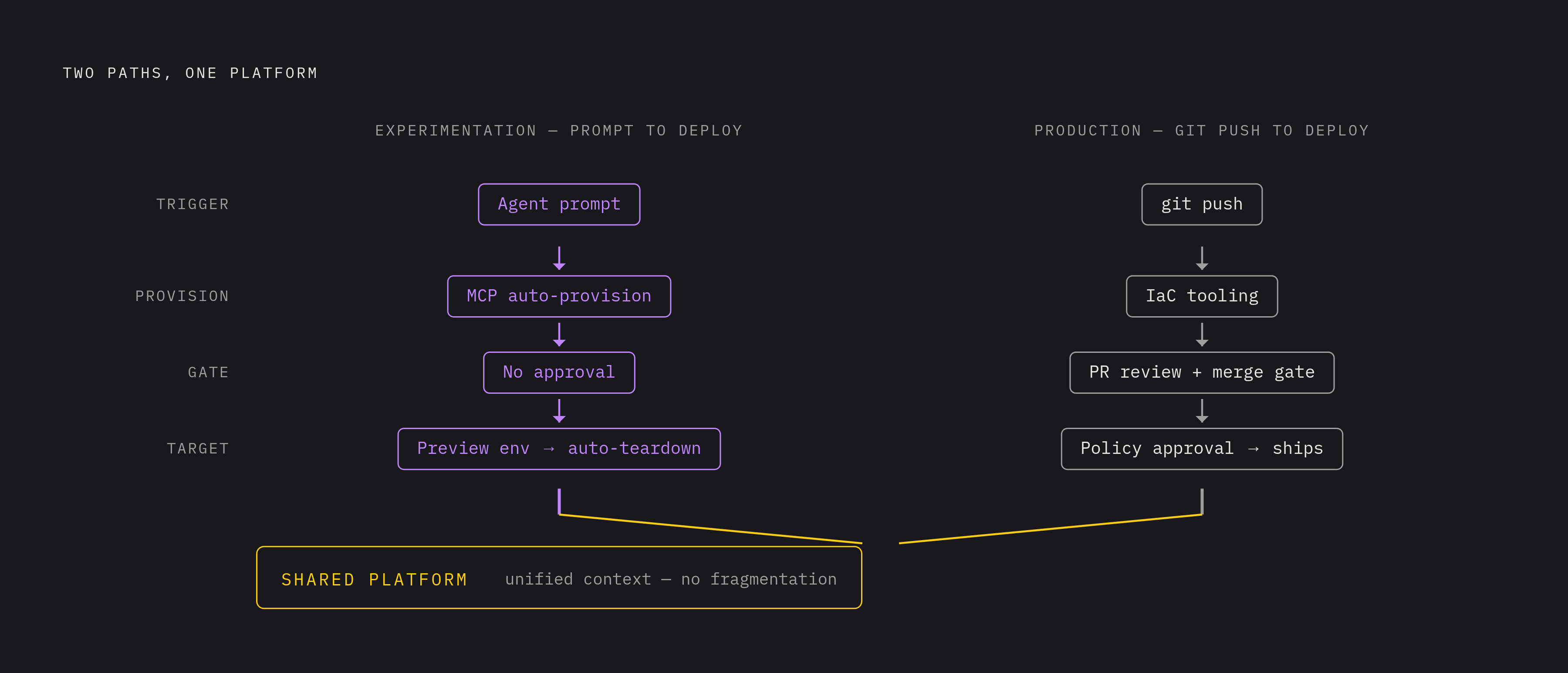
The unified engineering context layer as the prerequisite for all agent-native infrastructure
Every mechanism described so far, the merge queue, the tiered autonomy model, the self-correcting pull requests at Elastic, depends on agents operating from an accurate picture of the system they are working inside. A unified engineering context layer is the prerequisite for all of this infrastructure because when that picture is partial, stale, or inconsistent across tools, those mechanisms fail or produce output nobody can trust.
Without a single, continuously updated view of services, ownership, repositories, deployments, infrastructure, and incidents, along with the relationships connecting all of them, every agent and every workflow ends up working from a different, partial, and often outdated version of the truth. The failures that follow come from the context the agent was handed.
The DEV Community's September 2026 coverage traces what this looks like for a concrete task: an agent asked to deploy a microservice has to understand that service's architecture, identify the correct deployment environment, retrieve the approved configuration, build and test the change, scan the resulting artifacts, request deployment through an authorized workflow, verify the deployment's health, and report the outcome back. The chain is only as reliable as its weakest link, and every link depends on the same underlying context layer staying accurate and current.
The merge queue's tiered risk assessment needs an accurate picture of what changed and who owns it. If the context that agents and platforms draw from is fragmented across disconnected systems, none of that classification work is possible. Without an accurate context layer, the other four capabilities cannot function.
Sources
- Platform engineering for the agentic enterprise: Managing applications, resources, and AI agents | CNCF
- How agentic AI will reshape engineering workflows in 2026 | CIO
- Agentic AI in Platform Engineering (July 2026)
- Software Development Trends 2026: 5 Core Engineering Priorities
- Enterprise AI coding agent deployment in 2026 | Blog — Northflank
- The 4 levels of agentic software development
- AI Coding Agents in 2026: A Practical Roadmap from Autocomplete to Cloud Teammates | CodePick
- The Merge Queue Is the New Bottleneck - TianPan.co