Noisy Signal Problems in Agent-Driven CI/CD Pipelines
Agents amplify flaky tests and signal noise into pipeline-stopping failures.
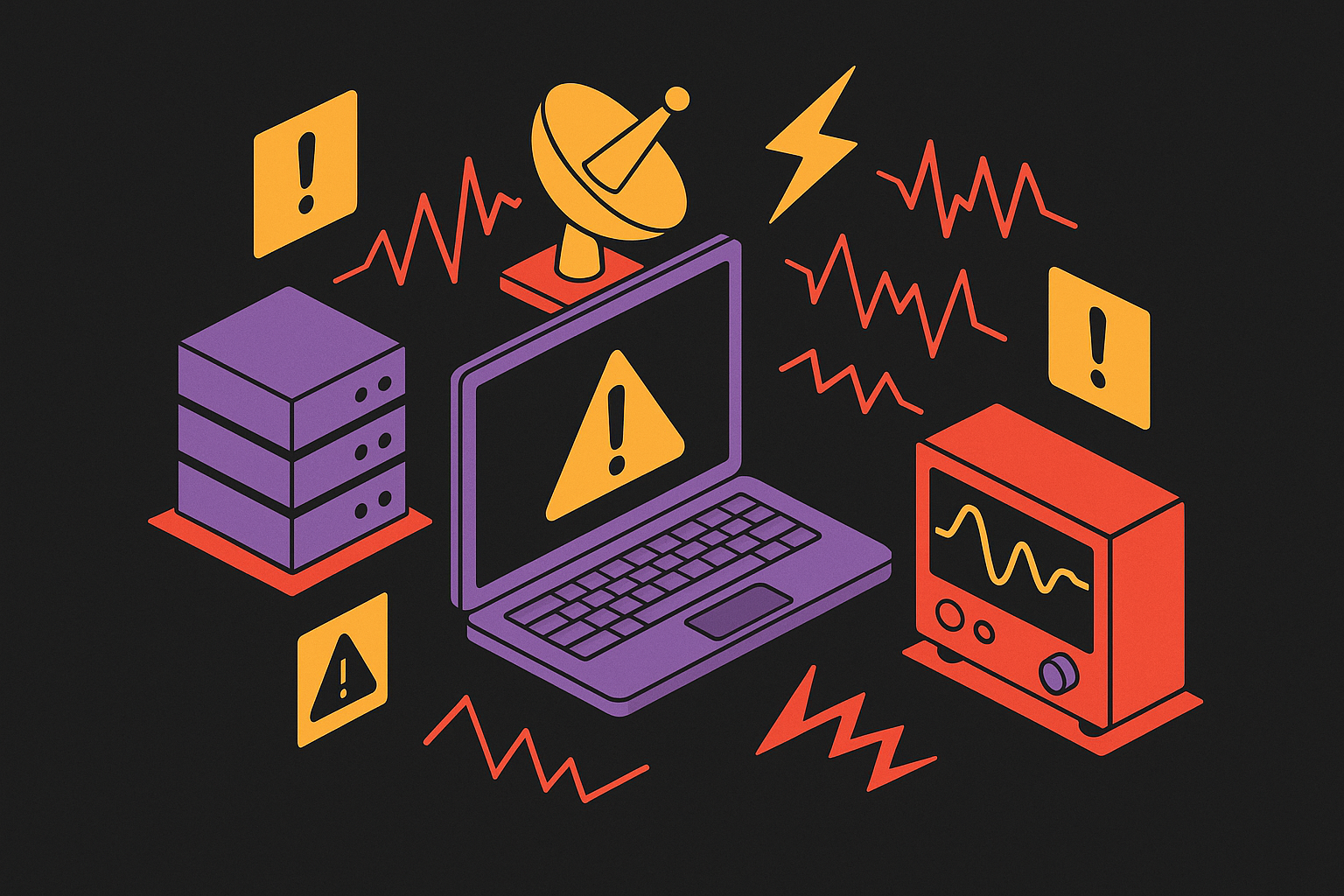
Agent-driven CI/CD pipelines don't just carry forward the noise problems that have always lived inside human-paced software delivery; they amplify them. The volume and cadence at which coding agents generate pull requests turns every tolerable noise source, every flaky test, every ambiguous status check, every unreliable canary signal, into something that can stop the pipeline cold. None of these problems are new. Flaky tests have annoyed engineering teams for as long as automated testing has existed, and ambiguous canary signals have always required some judgment to interpret. What has changed is how often these problems show up. A flaky test that once failed every few dozen human commits now fires on every cycle of an agent-driven merge queue, because agents produce pull requests all the time, not in the irregular rhythm of human work. An ambiguous canary signal that a human engineer might once have waved through, using context the pipeline itself doesn't capture, now blocks an agent that has no such judgment to exercise. Research on AI-augmented CI/CD pipelines frames this in terms of DORA metrics reported per pipeline run: when noise corrupts the data feeding those metrics, the closed loop that the entire software factory depends on breaks right where it starts.
How the merge queue turns flakiness into cascading failure
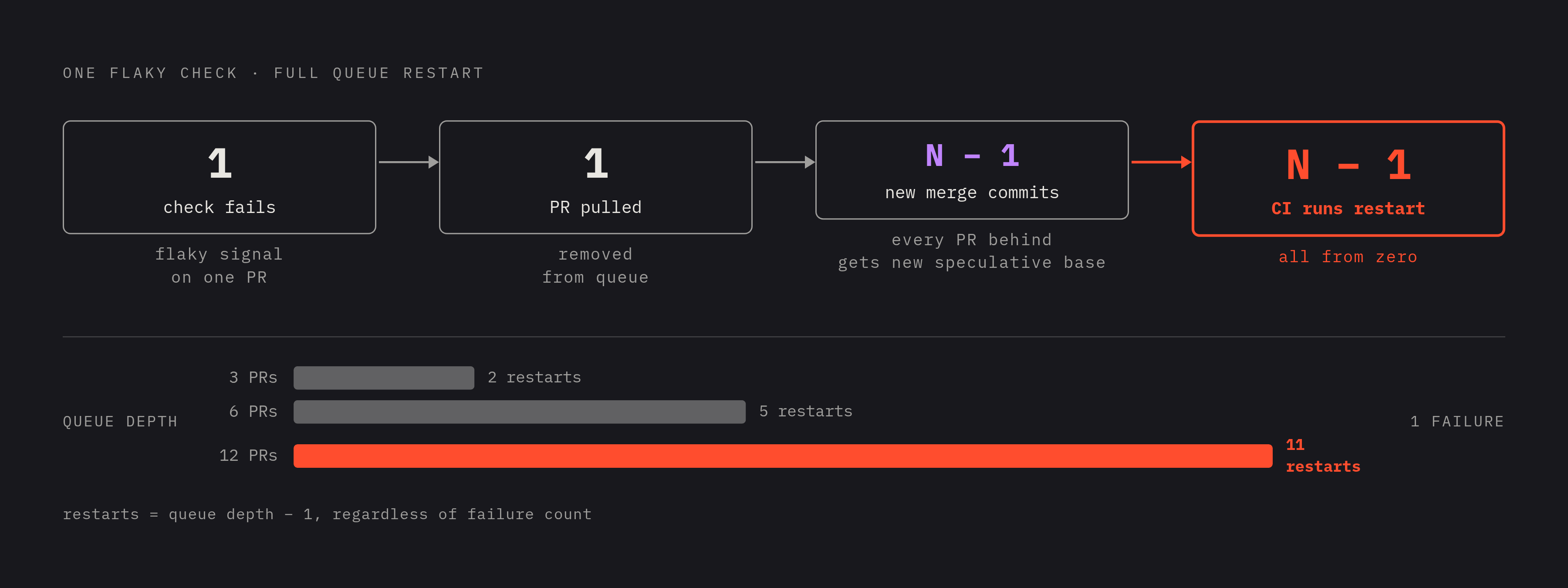
The merge queue is where a flaky test stops being a minor inconvenience and turns into a compounding system failure. A single bad signal inside a merge queue doesn't just cost the PR it touches. It restarts CI for every pull request sitting behind it. The mechanics are straightforward once you walk through them. A check fails on a queued entry, and that PR gets pulled from the queue. Every PR behind it now has a new speculative merge commit, because the base it was testing against just changed. Every one of those CI runs starts over from zero. This restart cascade is the single largest source of wasted pipeline capacity inside a high-volume merge queue, and it scales with queue depth rather than with the number of actual failures. At the PR volumes agent-driven development produces, you can nearly count on at least one flaky test firing in any given queue cycle. The cascade stops being a rare event and becomes the default operating condition of the queue. Research on AI-augmented CI/CD pipelines treats flakiness management and test triage as things a pipeline has to decide on its own, because human triage can't keep up with how fast agents generate throughput.
Some of this noise originates outside the code, in the environment the tests run in. Browser-based integration tests and slow end-to-end suites fail unpredictably under resource contention: when CI runners lack enough compute to run several jobs at once, timing-based timeouts fire as false positives that look exactly like code failures but have nothing to do with the code. Each of those false positives adds another restart to the cascade.
Engineers start treating the queue differently as a result of this deeper cost. Once reruns become routine, red builds stop carrying any real signal. Failure notifications turn into background noise that nobody reads closely, and a genuine regression can sit in the same queue as a dozen known-flaky tests without anyone noticing the difference. That erosion of trust in the pipeline's own output is the hinge the rest of this problem turns on.
The Cost of Signal Loss at Agent Velocity
Once pipeline signals lose credibility, the feedback loop the entire software factory runs on breaks down. Agents and engineers alike end up optimizing against noise instead of against what's actually happening in production, and that kind of error compounds across every PR it touches. A software factory works as a closed loop: monitoring what's already shipped produces signals that kick off the next round of agent work. When those signals are noisy, the loop breaks at its input, and agents get sent toward directions the real state of production never supported.
Research on AI-augmented CI/CD pipelines documents that ambiguous test failures and noisy canary signals still require heavy human interpretation, and that in complex environments this delays lead times by as much as 30%. That number undercuts the reason organizations adopt coding agents. Agents collapse the time it takes to write a feature from hours to minutes, which moves the real bottleneck downstream. When authoring code is no longer the slow part, everything between a finished change and a running production service is the constraint, and signal noise is the friction that keeps that gap wide open.
The most consequential failure mode in this category never appears in any test suite. An agent finishes a task, the tests pass, the change merges cleanly. Three days later, an unrelated team's CI starts failing because a downstream service still expects the old function shape the agent changed, something the agent had no visibility into when it made the change. The failure is a missing signal that no amount of flaky-test tooling or improvement to the merge queue's restart logic can catch. The contract between two services broke, and nothing in the pipeline was watching for it.
Signal loss carries a cost that outlasts any single incident. Once engineers get into the habit of dismissing red builds, the pipeline loses its standing authority to block a bad change from shipping. A regression that should have been caught in minutes instead reaches production, because the check's warning arrived indistinguishable from the usual noise.
Limits of standard flaky-test responses at agent scale
The usual playbook for pipeline noise, quarantining flaky tests, adding retries, tightening required gates, breaks down at the PR volumes agents generate. Each of these responses trades one failure mode for another, leaving unaddressed why the signal was unreliable.
Retries absorb compute and stretch out cycle time on every run, and at agent-driven volumes that cost multiplies fast across hundreds of changes a day. Quarantining a flaky test requires a human to judge which tests belong in quarantine and when they're reliable enough to graduate back into the required set, and that kind of judgment call doesn't scale to the pace agents operate at. Tightening gates makes the underlying problem worse rather than better: every additional required check is one more surface where flakiness can strike, and the more checks that can fail, the more cascade restarts the queue has to absorb. Loosening gates runs into the opposite problem. Moving a slow, unreliable integration test to informational status cuts down on restarts, but it also means the pipeline catches fewer real bugs, so you have to ask whether that check was ever actually catching production-breaking bugs or just performing the appearance of rigor.
The noise problem also appears at the level of raw output. Work from Red Hat on the cicaddy framework points to a related issue inside the logs themselves: a CI run can generate thousands of lines of repetitive output, more than enough to overwhelm the context window of an LLM trying to reason over it. Red Hat's approach uses a pre-processing tool called cordon to reduce those logs down to their semantic anomalies before a main analysis agent ever touches them, which makes a broader point: noise has to get filtered out before it reaches the reasoning layer, not cleaned up after the fact. The same logic applies to lint rules and linter error messages. A message that feels like a minor annoyance in a human-paced workflow becomes a multiplier once agents are the ones consuming it, because a poorly scoped signal source scales its damage in direct proportion to PR volume.
What all of these responses share is a shared blind spot. Quarantine, retries, and tighter gates all treat noise as a test quality problem to be managed. None of them treat it as what it actually is once agents become the primary consumers of pipeline signals: a classification problem.
Reclassifying signals before they reach the pipeline, the architectural shift that changes the problem
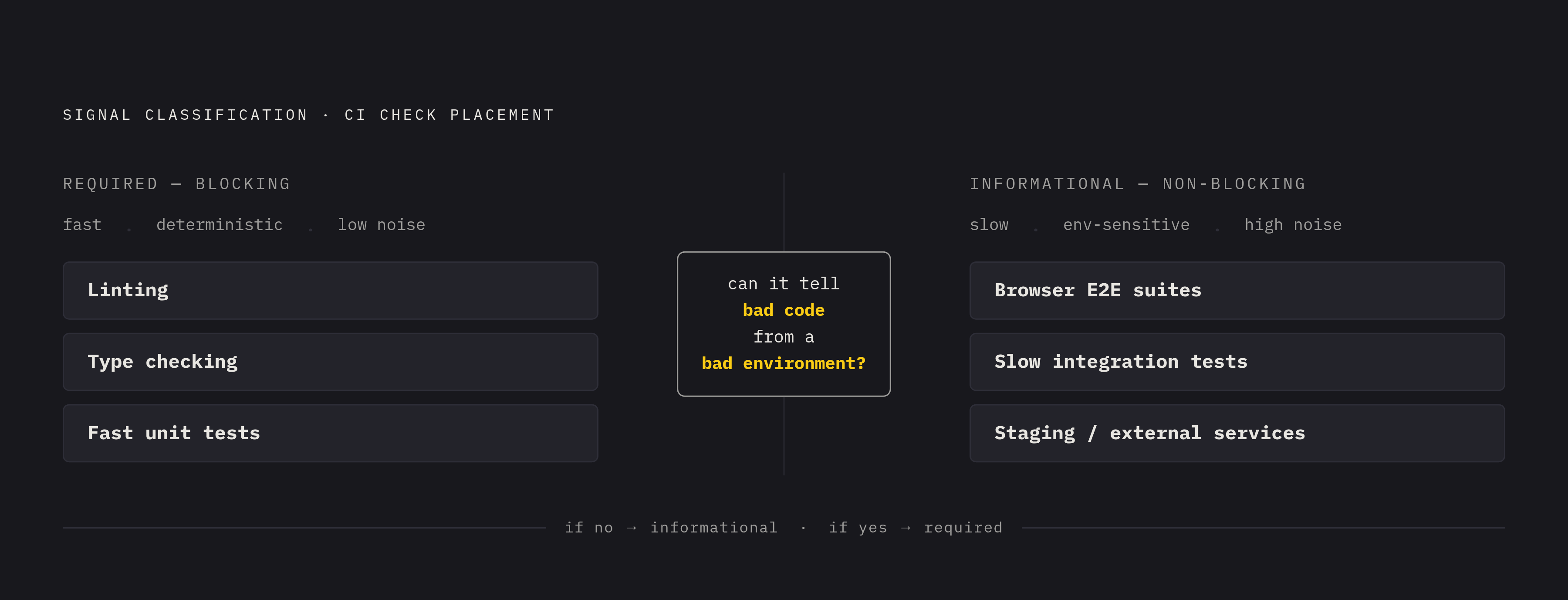
Solving noise at agent scale means you classify and route signals before they ever reach the merge queue, instead of building better recovery mechanisms for after a cascade has already started. That's a different kind of fix than anything quarantine or retry logic offers, because it changes what counts as a blocking signal in the first place rather than trying to manage the fallout once one fires.
The distinction that actually matters is between required checks and informational signals. Fast, deterministic checks, linting, type checking, fast unit tests, belong in the required set because they reliably catch real problems and fail quickly when something is genuinely wrong. Slow integration tests, browser-based end-to-end suites, and anything that touches a staging environment or an external service belong in an informational tier instead, because their failure rate carries too much environmental noise to serve as a trustworthy gate. The test for whether something belongs in the required set is simple: the check must reliably tell bad code apart from a bad environment. If it can't make that distinction, it has no business blocking a merge.
Log pre-processing gives you a working model for this kind of filtering. The cicaddy framework's approach, reducing raw CI output down to semantic anomalies before an LLM analysis agent ever sees it, applies just as well to the merge queue itself: strip repetitive, low-information content out of the signal before any agent acts on it. Cicaddy's execution model reinforces the same idea from another angle. A CI trigger fires, the agent runs autonomously through a bounded task, produces its output, and exits. That one-shot structure shows that agentic CI steps can be scoped tightly enough that each reasoning turn works against clean, pre-filtered input instead of raw, undifferentiated pipeline state.
None of this closes the gap described earlier, where an agent merges a change with no visibility into a downstream contract it just broke. Closing that gap means routing signals from running production services, exceptions, slow queries, failed deploys, directly into an agent's context before the next PR cycle starts. The hidden contract failure mode happens when that kind of production signal exists somewhere in the system but was never routed to the agent that needed it.
How platform teams are building signal-aware pipelines in practice
Platform teams that have stopped treating noise as a test problem and started treating it as a pipeline architecture problem are the ones making the closed-loop software factory work at agent speed. Red Hat's work on the cicaddy framework shows what that looks like concretely: existing CI/CD pipelines get extended with agentic steps. The deterministic stages a team already trusts stay exactly as they are. An LLM reasoning step gets slotted in only where it adds something a deterministic rule can't: pattern analysis, anomaly detection, report generation.
Cicaddy structures this around three agent types, and each one ties to a different kind of CI event. An MR Agent activates on merge request events, analyzes the code diff, posts review comments, and sends notifications. A Branch Agent activates on a branch push and runs branch-level analysis with commit comments folded in. A Task Agent activates on a schedule or a manual trigger and handles monitoring, report generation, data analysis, and other custom workflows. Each of these maps directly onto how CI systems already expose events, so the event model itself becomes part of how signals get classified from the start.
GitOps practices contribute a related structural fix. Environment drift, where a system's real state quietly diverges from what's declared in configuration, is one of the biggest sources of false-positive failures in CI. Continuous reconciliation against a declared source of truth removes that source of noise instead of managing it after the fact, which is the same philosophy driving the classification tiers described above: fix the structure that produces the noise rather than building better tooling to cope with it.
Cicaddy's security model reflects a design discipline you can carry over to any agent-operated pipeline step. The agent runs inside the same security boundary as any other pipeline step, in a containerized environment with no elevated privileges. That constraint limits how much damage a misclassified signal can do even when the agent gets something wrong, which matters more as agents take on a larger share of the judgment calls a pipeline used to leave to humans.
What an agent-operated merge queue contributes
A merge queue that can reason about why a failure happened, not just detect that one occurred, converts signal classification from a one-time configuration choice into something the pipeline does continuously. Static gates can't make that distinction. A failure is a failure, the PR gets removed, the queue restarts, every time, regardless of cause. That rigidity works fine when the underlying signal is reliable. It turns catastrophic the moment the signal is noisy, because the gate has no way to tell the two situations apart.
An agent-operated merge queue can ask the questions a static gate structurally cannot. Did this failure come from the PR's own changes, or from environmental flakiness that has nothing to do with the code? Is this a genuine blocking signal that needs a human to look at it, or a known-noisy signal that should be downgraded automatically? Does the failure pattern match a flaky test the system has already seen before, or is it a new failure mode serious enough to warrant escalation?
Graphite's Agentic Merge Queue puts this directly into practice: an AI agent handles merge conflicts, CI failures, and queue management on its own, so that human engineers only get pulled in for decisions that actually require judgment. In that design, the queue stops being a simple pass-fail gate and becomes a layer that actively classifies the signals passing through it. That's the architectural shift this entire problem has been pointing toward: a pipeline that filters noise before it can cascade will always outperform one that's merely faster at recovering once the cascade has already started.